
Document Storage Unit: Definition, Types, Features, Uses, and Benefits
Table of Contents
- What Is a Document Storage Unit?
- What Are the Features of Document Storage Units?
- What Are The Types of Document Storage Units?
- What Are the Use Cases of Document Storage Units?
- What Are the Benefits of Document Storage Units?
- How Does Document Storage Process Work?
- Ready to Move? Get Your Free Quote Today
A document storage unit acts as a dedicated space where paper records and important files are kept safe, organized, and easily retrievable. Document storage units offer combined features like controlled access, shelving and racking systems, climate and environmental controls, surveillance and alarm systems, and systematic labeling, indexing, and tracking.
Document storage is used by different businesses and organizations as they still generate and accumulate large volumes of paper documents in today’s digital age that require proper management and preservation. Physical document storage units provide a practical solution to handle this growing paper load while maintaining organization, security and accessibility. Document storage units are available in various types, including self storage units, mobile storage units, on-site storage units, off-site storage units, and climate-controlled storage units.
Storage units for documents are used for multiple purposes such as archiving business and financial records, managing employee files, supporting compliance, providing physical backups, and storing reference materials. The benefits of using document storage units include improved security, better organization, space optimization, long-term preservation, easy retrieval, and compliance support.
Managing large volumes of sensitive documents can become increasingly difficult due to limited office space, risk of misplacement, and strict compliance requirements during relocations or audits. So, hiring a professional document storage company provides a secure, organized, and compliant solution for storing and managing important business documents and personal records
What Is a Document Storage Unit?
A document storage unit is a secure, organized physical space or facility designed for storing, protecting, and managing paper records, files, and important documents. These storage units feature controlled access, shelving or racking systems, climate and environmental regulation, and security measures such as surveillance, alarms, and restricted entry to safeguard documents from damage, loss, or unauthorized access. Storage units for documents can be located on-site within an organization or off-site at professional storage facilities, providing businesses and individuals with a reliable solution for long-term record preservation, easy retrieval, and compliance with legal, regulatory and operational requirements.
What Is Document Storage ?
Document storage is the systematic physical storage of paper records, files, and important documents in secure facilities or designated on-site locations. It focuses on organizing, protecting, and preserving documents for easy retrieval, long-term retention, and safeguarding against damage, loss, or unauthorized access without involving digital or cloud-based solutions.
What Are the Features of Document Storage Units?
The features of document storage units include robust physical infrastructure, advanced security features, precise climate and environmental control, comprehensive compliance and regulatory support, efficient inventory tracking, and systematic organization systems (labeling, indexing, retrieval).
The features of document storage units are given below.
Physical Infrastructure
Physical infrastructure in document storage units refers to the sturdy and well-planned structural design and built environment of the storage facility, specifically developed to support the safe and organized storage of physical records. Document storage is composed of different parts like high-density shelving systems, fire-resistant construction materials, and reinforced building structures that enhance durability and protection of stored documents. Storage facilities are designed to accommodate large volumes of files and archival boxes with optimized capacity planning that allows systematic stacking, categorization, and long-term storage.
Storage companies maximize efficiency and protection through structured layout planning of document storage units that organizes the facility into clearly defined zones such as intake, active storage, and archival sections. Storage companies design wide, well-marked aisles for safe movement and quick retrieval of stored documents. The facilities for document storage arrange shelving systematically based on box size and category to prevent overcrowding and reduce damage while handling. Spacing between racks, controlled stacking heights, and designated pathways in document storage units help minimize physical stress on documents and lower the risk of misplacement or accidental damage.
Security Features
Document storage units incorporate security features such as 24/7 CCTV surveillance, restricted access controls, and continuous on-site or automated monitoring to safeguard sensitive records. Document storage units use a multi-layered security architecture, combining perimeter security (gates and fences), controlled entry points, internal access restrictions, and secure storage zones to create multiple levels of protection.
The security features of document storage units prevent unauthorized access to confidential documents, theft or exposure of sensitive records by guaranteeing that only approved individuals can enter the facility and access specific storage areas. Entry controls of document storage facilities verify user identity and surveillance systems of the storage premises record and deter suspicious activity. Monitoring systems of the facility track movements to ensure the security of documents.
Document storage providers in the UAE are assessed based on internationally recognised certifications like ISO 27001 and ISO 9001 that validate how securely they manage sensitive records. ISO 27001 certification defines an information security management system and verifies that the provider applies documented controls for handling, transferring, and storing confidential records. ISO 9001 certification defines a quality management system and ensures that processes such as intake, indexing, retrieval, and disposal follow consistent, audited procedures. Enterprise clients in sectors such as finance, healthcare, and legal services in the UAE often review both certifications to confirm that a document storage company meets established international standards.
Climate and Environmental Control
Climate and environmental control in document storage units refers to systems that regulate internal conditions to prevent deterioration of physical records. These facilities maintain a stable temperature around 18 to 22°C (64 to 72°F) and a humidity level of 45 to 55% to avoid issues such as paper brittleness, ink fading, and structural weakening caused by excessive heat, dryness, or moisture fluctuations. Consistent regulation of temperature and humidity levels in storage units for documents helps preserve the physical structure and readability of documents over time.
Storage units for documents have integrated environmental systems such as dehumidifiers, air filtration, and controlled ventilation that protect documents from mold, excess moisture, warping, and pest infestations. These climate control systems in document storage units support long-term preservation by maintaining clean and stable storage conditions that keep documents intact, legible, and usable for extended periods.
Climate control is important in the UAE because outdoor summer temperatures in cities such as Dubai, Sharjah, and Abu Dhabi regularly exceed 45°C between June and September, while coastal humidity often rises above 80% during the same period. Unventilated warehouses, garages, and standard storage rooms can reach internal temperatures of 55 to 60°C during peak summer, creating conditions that cause paper records to fade, become brittle, warp, or develop mold. Climate-controlled document storage units address these risks by maintaining indoor temperatures between 18 and 22°C with regulated humidity levels, helping preserve paper records in stable condition throughout the year.
Compliance and Regulatory Support
Document storage units are designed to comply with industry regulations and legal requirements by implementing standardized processes for document handling, storage, and retrieval. Storage providers use controlled access systems, detailed audit trails, and documented procedures to ensure that stored information meets regulatory expectations. They also apply retention schedules to make sure that documents are stored for legally required time periods and securely disposed of when no longer needed.
UAE compliance requirements also extend to the licensing status of the service provider, particularly when it comes to secure document destruction. Shredding of confidential documents should be carried out only by third-party vendors in Dubai that are approved by Dubai Municipality, which regulates waste handling and disposal activities across the emirate. Customers should verify that their document storage provider holds valid Dubai Municipality approval before handing over sensitive records for shredding, so that the entire document destruction process remains properly documented and compliant with local regulations.
Document storage facilities are structured to meet compliance standards through secure infrastructure, monitored environments, and systematic record organization using indexing and labeling systems. These practices make it easier to locate, track, and produce compliance-related records like financial statements, tax filings, corporate contracts, and legal agreements during audits, legal reviews, or regulatory inspections.
Using compliant document storage units helps organizations meet regulatory record-keeping obligations such as defined retention periods, confidentiality, and accurate retrieval efficiently, while reducing the risk of penalties, legal issues, and data mismanagement.
Planning a Move? Let the Experts Handle It
From home moves to office relocations, our professional movers ensure safe packing, timely transport, and stress-free moving. Get expert help today.
Get a Free Moving QuoteInventory Tracking
Document storage facilities track inventory by assigning a unique identifier to every file, box, or record at the time of intake. Each item is labeled and logged into a tracking system along with details such as document type, storage location, and access history. The status of documents is updated as documents are stored, moved, or retrieved to maintain an accurate record of their exact position within the facility.
Storage facilities for documents use efficient tracking systems such as manual cataloging, barcode tracking, and digitized inventory management. Manual systems such as handwritten logs, file folders with labels, card catalogs, and paper-based indexing systems involve detailed logs, labeling, and indexing of files. Barcode scanning systems allow staff to scan and track documents efficiently in real-time with minimal error. Digitized tracking systems store all inventory data in searchable databases for quick identification and retrieval of files.
Both manual cataloging and digitized tracking methods are used to maintain organized records. Manual systems involve detailed logs, labeling, and indexing of files, while digitized inventory management systems store this information in databases for quick search and retrieval. Barcode scanning enhances accuracy by reducing human error and enabling real-time tracking of document movement.
Organization Systems (Labeling, Indexing, Retrieval)
Organization systems in document storage units are designed to structure records using labeling, indexing, and logical classification methods for efficient management. Documents are labeled with unique identifiers such as barcodes, alphanumeric codes (e.g., BOX-001, FILE-A23), or client-based tags while indexing systems categorize records based on criteria like date, document type, department or client name. For example, financial records may be indexed by fiscal year while legal files may be organized by case number or client ID.
Storage facilities use structured filing frameworks that combine these methods into a consistent system such as hierarchical classification, where documents are organized by company, then department, followed by document type and finally by date, or sequential storage based on reference codes.
The retrieval process of stored documents and files is systematic and precise in which when a document is requested, staff use the indexing or digital inventory system to identify its exact storage location. The on-site staff locate the file using its label or barcode, retrieve from its designated shelf or section, and deliver it to the requester. The document is returned to the same recorded position after use to maintain organization and tracking accuracy.
What Are The Types of Document Storage Units?
The types of document storage units include self storage units for documents, mobile storage units for documents, on-site document storage units, off-site documents storage units, and climate controlled document storage units.
The types of document storage units are explained below.
Self Storage Units for Documents
Self storage document units are off-site storage spaces rented by individuals or businesses where they store physical records, files, and paperwork in a secure and organized environment. These self-storage units are considered a cost-effective alternative to maintaining in-office storage because they reduce the need for additional workspace, shelving infrastructure, and long-term facility overhead costs. Many self-storage units have enhanced storage conditions such as pest control measures and climate-controlled units which help to protect sensitive documents from humidity, temperature fluctuations, and physical damage over time.
Self storage facilities for documents are equipped with strong security systems, including gated access, surveillance cameras, secure lockers or rooms, adequate lighting, and on-site guards and management staff. These security measures guarantee that stored documents remain protected from unauthorized access and theft.
These self storage units for documents provide flexible accessibility to stored documents which allows you to access your documents at convenient hours, making it easier to retrieve or store documents without operational delays. Self storage document units are particularly suitable for small businesses and individuals who need reliable document storage without investing in large-scale or enterprise-level storage solutions due to their affordability, full control and moderate capacity.
Mobile Storage Units for Documents
Mobile storage units for documents are portable storage containers designed for document storage that are delivered directly to your location which allow you to store documents on-site and off-site. This means the storage container either remains at the location for easy access or be transported to a secure storage facility, depending on your needs.
They are especially useful for temporary document storage as they simplify the process of packing, storing, and relocating records without requiring multiple handling steps. This makes mobile storage units ideal for situations such as office moves, renovations, or short-term archiving where quick and efficient storage for documents is required.
Mobile storage units come in flexible sizes which allows you to choose the capacity of the storage unit based on your document volume. Mobile storage units for documents include a variety of features such as secure doors and reliable locking systems. These storage units have options for controlled storage conditions like regulated temperature and humidity to keep the documents organized, protected, and easily manageable throughout the storage period.
On-Site Documents Storage Units
On-site document storage units are storage systems placed within or near the organization’s premises, used to store physical records, files, and important documents for direct and immediate access. On-site storage units for documents include dedicated storage rooms, filing systems, or secure cabinets and lockers designed to keep documents organized and easily retrievable within the workplace.
They provide immediate access to frequently used records which make on-site document storage units a practical solution for day-to-day operations where quick document retrieval is essential. Organizations that rely on regular access to files such as administrative offices, legal teams or finance departments commonly use on-site storage units to quickly retrieve contracts, invoices, client records, and other essential documents without delays, reducing downtime and ensuring that critical business processes continue smoothly.
Off-Site Documents Storage Units
Off-site documents storage units are secure storage facilities located away from a business’s primary premises, designed for long-term archiving of physical records and important documents. These storage units provide a reliable solution for organizations that need to store large volumes of records without occupying valuable office space. Off-site documents storage units are equipped with advanced security features like controlled access, surveillance cameras, 24/7 monitoring, alarm systems, and on-site guards and staff.
Off-site storage units are managed by professional staff management companies which use systematic indexing, labeling, and cataloging methods to maintain organized storage. This managed approach allows businesses to archive, retrieve, and track documents quickly. Off-site storage units for documents are ideal for long-term storage and compliance with regulatory record-keeping requirements.
Climate Controlled Document Storage Units
Climate controlled document storage units are specialized storage spaces designed to maintain stable environmental conditions such as regulated temperature and humidity levels to protect sensitive records. Climated controlled storage units for documents are ideal for storing documents that are vulnerable to deterioration caused by environmental changes.
Advanced climate controlled storage systems protect documents against mold, moisture, pests and paper degradation by maintaining temperature and humidity within controlled ranges from 18 to 22°C (64 to 72°F) and 45 to 55% relative humidity. This controlled environment preserves the integrity of documents over long periods and prevents damage that occurs in standard storage conditions.
Businesses and individuals use climate controlled storage services to safeguard sensitive, confidential or historical documents that are sensitive to temperature and humidity fluctuations and require careful preservation such as legal records, medical files, archival materials, and rare manuscripts.
What Are the Use Cases of Document Storage Units?
The use cases of document storage units include business archiving, secure financial record storage, employee file management, operational record keeping, compliance documentation, physical backup of critical files, and occasional access to reference materials.
The use cases of document storage units are explained below.
Business Archiving
Document storage units are used for the long-term preservation of rarely accessed documents that remain important for business, legal or regulatory purposes. These storage units provide a secure and organized environment to store contracts, historical company records, reports, invoices, financial records, and corporate files that do not require daily access but must be retained for reference, compliance or historical value. Businesses reduce operational clutter, lower storage costs, and ensure the long-term preservation of important records by outsourcing archiving to professional storage units providers.
Financial Records
Financial documents such as balance sheets, income statements, tax returns, audit reports, payroll records, and bank statements contain sensitive information that requires secure handling. Document storage units are used to protect these records and maintain the confidentiality of financial information. These facilities provide controlled access and structured storage to maintain confidentiality and prevent unauthorized handling of financial data. Businesses and individuals use document storage services to store and keep financial records such as invoices, receipts, tax files, bank statements, and payroll data for auditing and taxation requirements where accurate record-keeping and timely retrieval are essential. Document storage units support regulatory compliance while keeping important financial documents secure, organized, and readily accessible during financial reviews or legal verification.
Employee Files
Businesses store employee files in document storage units to maintain organized records of staff information, employment contracts, performance reviews, disciplinary actions, payroll documents, and personal information for long-term record keeping and HR compliance. These facilities maintain strict confidentiality through secure access controls so that only authorized HR personnel can view sensitive data while protecting employee privacy and meeting legal obligations.
Contracts
Individuals and businesses use document storage units to securely store legal agreements, vendor contracts, partnership documents, and service agreements. Storage units keep contracts organized which allows quick retrieval for reference, renewals, audits, or dispute resolutions. Storing contracts in document storage units provide protection from loss, damage or unauthorized access, safeguarding business and personal interests.
Business Records
Document storage units are used for storing operational records such as reports, project files, meeting minutes, and internal documentation, making them a practical solution for managing day-to-day business information that must be retained beyond immediate use. Businesses use document storage units to maintain structured business records that streamline operations, support business continuity, and provide reliable historical reference when reviewing past decisions, projects, or operational activities. Secure storage of business records helps safeguard sensitive information, preserves the company’s operational history and gives quick access for decision-making, audits, or compliance checks.
Compliance Management
Businesses use document storage units for storing documents required to maintain legal or regulatory compliance and keeping important documents properly organized and maintained over required retention periods. These records are kept readily accessible for inspections, audits, and regulatory reviews where accurate documentation and timely retrieval are essential. Documents that are stored for compliance purposes include tax returns, financial statements, audit reports, employee records, contracts, and regulatory filings which must be preserved in a structured and accessible manner.
Backup Documents
Businesses and individuals use document storage units as a secondary location for important files, storing duplicate or secondary copies of critical records as physical backup storage. Document storage units help protect essential business documents against data loss caused by disasters, system failures, or office-related incidents while keeping backup records secure, organized, and accessible when needed.
Reference Documents
Organizations use document storage units to store records that are not required for daily operations but are still needed occasionally for verification, research or decision-making. Reference documents include past project files, closed case records, historical financial data, contracts, reports, and policy documents that serve as a reference when reviewing past activities or making informed decisions. Keeping such records in storage units allows businesses to access them when required for occasional consultation without occupying active office space.
What Are the Benefits of Document Storage Units?
The benefits of document storage units are enhanced protection and preservation of sensitive documents through secure facilities, climate control, and organized, indexed storage for easy access. They also reduce costs, save office space, offer flexible unit sizes, support quick setup, and guarantee secure, tracked documents retrieval for improved operational efficiency.
The benefits of document storage units are given below.
Document Security
Document storage units provide strong protection to sensitive business documents and confidential records by using secure off-site facilities. These facilities limit entry to authorized staff only which prevents unauthorized individuals from accessing important files. The surveillance systems in document storage units continuously monitor the storage areas to guarantee the protection of your documents from theft, loss, or misuse.
Document storage units provide physical safety to your documents by storing your paper files, legal documents, and business records inside secure buildings. These buildings are equipped with alarm systems that immediately respond to any break-in attempt and help protect documents from damage or unauthorized handling. This complete security setup supports document confidentiality by keeping sensitive documents safe, private, and accessible only to approved users.
Climate Protection
Document storage units provide climate protection to your sensitive documents such as contracts and historical documents by maintaining controlled temperature levels. This temperature control protects paper files and printed records from heat damage which otherwise causes ink fading, paper dryness, and loss of important information. This climate protection keeps your documents stable and usable for long-term storage.
These climate storage units regulate humidity to protect paper documents and archived records from moisture-related issues. Proper humidity control inside them helps in preventing mold growth on stored contracts and also stops paper deterioration such as weakening or tearing. This humidity-regulated system in document storage units preserves the quality, readability, and lifespan of important documents by protecting them from environmental risks such as moisture damage, mold growth, paper warping, ink fading, and deterioration.
Easy Access
Document storage units provide easy access to business files, records, and documents through organized filing systems. They store documents in labeled folders and categorized sections which helps users locate specific files without confusion. Clear labeling on documents supports quick identification of stored documents which improves retrieval speed and reduces time spent searching.
These storage units of documents improve their accessibility by using indexing and cataloging systems for stored records. Indexing assigns specific codes or references to each document which provides fast tracking and easy retrieval when needed. Indexing and cataloging guarantees that the required files, backups, and important records are quickly accessible without delays.
Cost Efficiency
Document storage units reduce office space expenses by moving physical files, business records, and archived documents out of expensive office areas into secure off-site facilities. This shift lowers the need to use valuable office space for storing documents which directly reduces operational costs related to in-house document storage. You can use your office space more efficiently for core activities instead of file storage.
Offsite document storage reduces costs by minimizing the need for staff time spent managing, organizing, and searching physical documents. It especially lowers expenses related to environmental control systems such as maintaining temperature and humidity for stored files within the office. You can easily save on space maintenance costs including cleaning, shelving, and storage infrastructure because documents are securely stored and managed offsite.
Flexible Sizes
Document storage units offer flexible unit sizes to store different volumes of documents, files, and business records. You can choose smaller units for limited records or larger units for extensive archives because each document has adequate space without overcrowding. This flexibility helps maintain an organized storage system and protects files from damage caused by tight or improper storage.
This customizable storage capacity becomes highly useful as business records grow over time. Companies easily upgrade to larger units or adjust their storage allocation to accommodate increasing volumes of contracts, reports, or historical documents. The flexible sizes of document storage units help store records safely without the need for constant office rearrangements or costly expansions.
Quick Setup
Document storage units support quick setup by allowing businesses and individuals to store files, contracts, and important documents without lengthy preparation. Offsite document storage facilities are designed to be ready-to-use so you can move their records into storage immediately which saves time and effort compared to setting up in-house storage systems.
Document storage units focus on a simple onboarding process for your documents by providing prepped and organized units that do not require complex assembly or preparation. Businesses can start storing documents securely and efficiently from day one which guarantees a smooth transition to off-site storage without operational delays.
Space Optimization
Offsite document storage units provide valuable free office space by moving files, archived records, and bulky documents out of the main workplace. This reduction in in-office storage clutter helps improve workplace organization and allows you to maintain a cleaner and more efficient office design. With documents safely stored offsite, you can access your workspace without obstruction which enhances your focus and productivity.
The freed-up office space after transferring your documents to document storage units can then be used for employee workstations, meeting areas, or other business operations. Companies optimize their office layout, improve workflow, and make better use of their physical resources for growth and day-to-day activities with the help of off-site document storage facilities.
Secure Retrieval
Document storage units offer a controlled process for retrieving stored files, contracts, and business records by requiring strict authentication and authorization checks before any document is released. This guarantees that only approved personnel can access sensitive documents, protecting them from unauthorized use or loss.
Off-site document storage facilities also provide a document tracking system that updates the status of each record after retrieval. This tracking system keeps a precise log of which documents were accessed, by whom, and when which provides accountability and maintains the integrity of all stored records. You can securely retrieve files while keeping document records accurate and up-to-date.
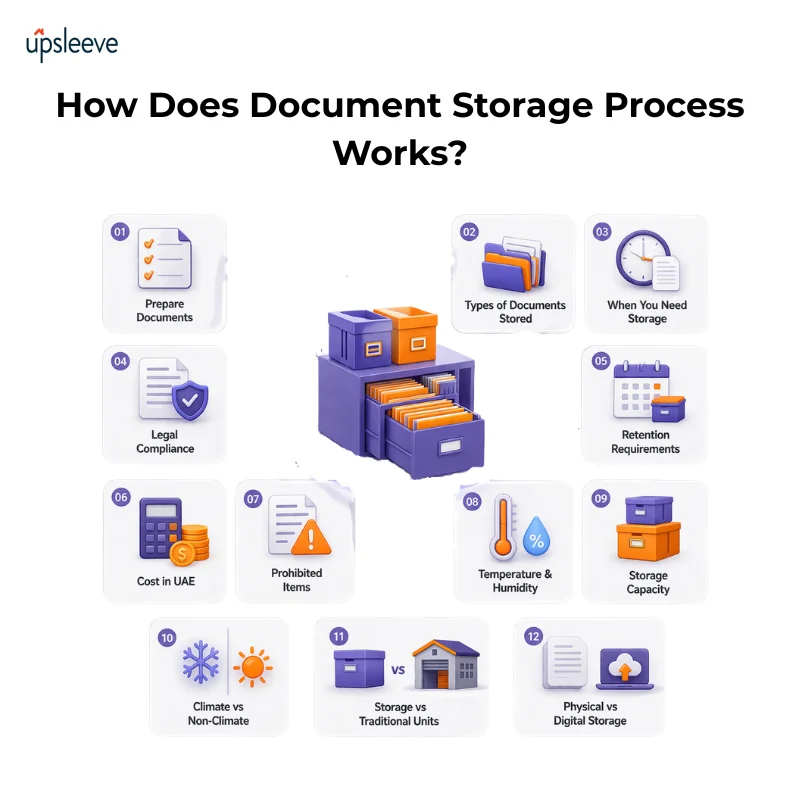
How Does Document Storage Process Work?
The document storage process works in the steps given below.
- Document Pickup by the Storage Company: The document storage company collects documents directly from the client’s office or location for transport to the storage facility.
- Secure Transport: Documents are transported in sealed, secure vehicles to prevent loss, theft or damage during transit.
- Intake Verification: Upon arrival, each document is checked for completeness and condition to ensure nothing is missing or damaged.
- File Indexing: Documents are categorized and indexed by type, date, or client for easy organization and future retrieval.
- Inventory Registration: Every file is recorded in the storage system, creating a digital or physical log for tracking purposes.
- Secure Storage: Documents are stored in climate-controlled, fire-resistant and secure units to maintain safety and longevity.
- Access Control: Only authorized personnel can access the stored documents for maintaining confidentiality and protection.
- Document Retrieval: Files can be quickly located and retrieved using the indexing system for efficiency when needed.
Retention & Disposal: Documents are retained in accordance with the client’s retention schedule or legal requirements and are securely destroyed at the end of the retention period using approved cross-cut shredding methods, with a Certificate of Destruction issued to confirm compliant disposal.
How to Prepare Documents Before Storage?
To prepare the documents before storage, follow the steps given below.
- Collect All Documents: Gather all important papers from offices, home or archives in one place to ensure nothing is missed before storage.
- Discard Unnecessary Papers: Sort out old, duplicate or irrelevant documents to save storage space and keep your filing system organized.
- Cut Sensitive Records: Remove or redact confidential information to protect privacy and prevent data breaches.
- Clean and Prepare Documents: Dust off, repair torn edges and flatten documents to keep them in good condition for long-term storage.
- Sort the Documents by Category: Organize files by type, date,or importance for quick and easy retrieval when needed.
- Create Digital Copies: Scan or photograph documents to create electronic backups for safety against loss or damage.
- Use Premium Storage Materials: Store papers in acid-free folders, boxes or protective sleeves to prevent yellowing and deterioration.
- Pack and Label Containers: Place documents carefully in boxes or files and label them clearly with categories, dates or references.
- Store Documents Upright: Keep files standing vertically to avoid bending, warping or pressure damage over time.
What Documents Are Stored in Document Storage Units?
Documents that are stored in document storage units are given below.
- Legal Documents: Legal documents such as contracts, court documents, licences and permits are stored in document storage units to keep them secure, organized and easily accessible for legal compliance and future reference. These documents are critical for audits, disputes or regulatory checks, so proper storage helps prevent loss or damage.
- Financial Documents: Financial documents such as invoices, receipts, tax filings, audit reports and ledgers are stored to maintain accurate financial records and support accounting processes. Secure document storage units make sure that these records are protected, well-organized and readily available for audits, tax submissions and financial analysis.
- Corporate & Business Records: Corporate and business records include employee HR files, project proposals, operational manuals, client agreements, and performance reports that are stored to manage staff, track project progress, and guarantee operational consistency. Storing them securely allows authorized personnel quick access while protecting sensitive business data.
- Personal Documents: Personal documents such as ID documents, certificates, personal contracts, passports, marriage certificates, rental agreements and educational transcripts are stored to keep important personal records safe and preserved. Document storage units protect these sensitive documents from damage, loss, misplacement or deterioration for personal or official use when required.
When You Need a Document Storage Unit?
You need a document storage unit when your office space starts to feel cluttered with files, contracts, and archived records and when document retrieval takes too long due to disorganized filing or a lack of indexing systems. It is a clear signal to consider off-site storage if you are spending excessive time and resources on managing, protecting, or maintaining physical records.
You need a document storage unit when sensitive documents are at risk of damage from heat, moisture, or unauthorized access. A document storage unit helps streamline storage by keeping important documents safe and accessible when your growing business records begin to impact office workflow and operational efficiency.
What Legal Compliance Requirements Apply To Document Storage for Businesses?
The legal compliance requirements that apply to document storage are Federal Decree‑Law No. 45 of 2021, UAE Tax Procedures Law, Corporate Tax Law, and the Commercial Companies Law. In the UAE, laws like Federal Decree‑Law No. 45 of 2021 (Personal Data Protection Law) require the protection of personal and sensitive data. UAE Tax Procedures Law (Federal Decree‑Law No. 28 of 2022) and Corporate Tax Law (Federal Decree‑Law No. 47 of 2022) mandate retaining financial, tax, and accounting records for specified periods. The Commercial Companies Law requires businesses to maintain corporate and statutory records to comply with governance and regulatory standards.
UAE federal laws apply to mainland businesses, while companies registered in financial free zones are subject to additional data protection rules that work alongside their document storage agreements. Businesses in the Dubai International Financial Centre are governed by the DIFC Data Protection Law No. 5 of 2020, enforced by the DIFC Commissioner of Data Protection. Businesses in the Abu Dhabi Global Market, on the other hand, follow the ADGM Data Protection Regulations 2021, enforced by the ADGM Office of Data Protection. These frameworks, applied to both physical records and digital files, set clear requirements for how personal data is handled, transferred outside the free zone, and reported in the event of a data breach. Free zone companies should ensure their document storage arrangements comply with the specific regulatory regime that applies to their business before entering into any agreement.
What Are the Legal Document Retention Requirements for Different Industries?
The legal document retention requirements for different industries are that financial and corporate businesses must keep accounting, tax and corporate records for five to seven years. Value Added Tax (VAT)-registered businesses are required to store invoices and tax returns for five years, and certain capital or real estate records for ten to fifteen years. Healthcare providers must retain patient medical records for at least five years to ensure proper access and legal compliance. Employment and HR records, including contracts and payroll, should be kept for seven years after an employee leaves to meet labor regulations and support audits or legal requirements.
Financial institutions licensed by the Central Bank of the UAE are subject to additional retention requirements beyond general tax and corporate timelines. Section 16.29.1 of the CBUAE Rulebook requires licensed institutions to keep key records such as KYC documents, customer verification files, monitoring records, business correspondence, and copies of identification documents for at least five years after a transaction is completed or a customer relationship ends. This requirement applies to banks, finance companies, exchange houses, and insurance firms regulated by the Central Bank.
Clinics and hospitals in the UAE are regulated by different authorities depending on where they are licensed. Facilities in Dubai are overseen by the Dubai Health Authority (DHA), those in Abu Dhabi are regulated by the Department of Health – Abu Dhabi (DOH), and federally licensed facilities fall under the Ministry of Health and Prevention (MOHAP). Each authority sets its own rules for how long patient medical records must be kept and how they should be protected, so healthcare providers need to align their document storage and disposal practices with the requirements of their specific regulator.
How Do Free Zone Record-Keeping Rules Affect Document Storage?
Free zone record-keeping rules affect document storage by introducing additional compliance requirements alongside federal tax and corporate laws. Companies registered in UAE free zones must maintain statutory registers, accounting records, and corporate documents in line with the rules set by their respective authority. This applies to entities in the Dubai Multi Commodities Centre, Jebel Ali Free Zone Authority, Dubai International Financial Centre, Abu Dhabi Global Market, and Ras Al Khaimah Economic Zone. Document storage clients operating across multiple zones should confirm the retention period for each entity separately, since the longest requirement across both federal and free zone regulations determines how long records must be kept.
What Is the Cost of a Document Storage Unit in the UAE?
Document storage units in the UAE cost between AED 150 and over AED 3,000 per month, depending on size and provider. Small lockers (15 to 25 sq ft) cost AED 150 to 400 per month, medium units (~50 sq ft) range from AED 700 to 1,400 per month, large units (100+ sq ft) cost between AED 1,000 to 3,000+ and by-the-box storage starts around AED 95 per month.
Storage, pickup, retrieval, and destruction services are subject to 5% value added tax (VAT) under Federal Decree-Law No. 8 of 2017 on Value Added Tax, which means the final invoice amount is the listed price plus 5%. Licensed providers are required to display their Tax Registration Number (TRN), issued by the Federal Tax Authority, on every invoice. VAT-registered businesses can recover this amount as input tax through their regular VAT returns.
What Items Are Prohibited From the Document Storage Unit in the UAE?
Items that are prohibited from the document storage units in the UAE include any items that are not related to documents such as cash, jewellery, electronics, or personal belongings. Prohibited items also include hazardous materials, flammable substances, illegal goods and drugs, perishable food, live animals and plants, unlicensed weapons such as firearms and ammunition, pressurized cylinders like gas tanks, toxic or corrosive chemicals and counterfeit or unauthorized goods. Only official records, files, and other document-related materials suitable for safe storage and retrieval are permitted.
Are Stored Documents Insured in the UAE?
Yes, stored documents in the UAE are covered by a baseline insurance policy included in standard storage agreements. Providers generally offer a default level of coverage, with optional extended insurance available for high-value corporate archives or irreplaceable records. Exact coverage amounts, limits, and exclusions vary from one provider to another, so clients should review the storage agreement carefully before handing over any documents and request written confirmation of the insurance coverage. Prohibited items are usually excluded from coverage even when insurance is in place. Providers also require a documented inventory at the time of handover, when the documents are first received into storage, to ensure that any future claim can be accurately matched to the stored contents.
What Is the Ideal Temperature and Humidity Levels in a Climate Controlled Document Storage Unit?
The ideal temperature and humidity levels in a climate-controlled document storage unit are 60 to 70°F (16 to 21°C) with a relative humidity of 30 to 50% which provides long-term protection of documents from moisture, mold and deterioration.
What Is the Storage Capacity of a Document Storage Unit?
The storage capacity of a document storage unit ranges from 1,000 to over 100,000+ documents depending on its size. Small document storage units hold 1,000 to 5,000 documents, suitable for personal offices or home use while large document storage units store 50,000 to 100,000+ documents, ideal for businesses, archives and long-term record management.
What Is the Difference Between Climate-Controlled and Non Climate Controlled Document Storage Units?
The difference between climate-controlled and non-climate controlled document storage units involves differences in their temperature control, humidity control, protection level, document safety, cost and environmental stability. Climate-controlled units keep documents safe in a stable environment while non-climate controlled units provide basic storage without regulating conditions.
The differences between climate controlled and non-climate controlled document storage units is given in the table below.
Aspect | Climate-Controlled Document Storage Units | Non Climate Controlled Document Storage Units |
Temperature Control | Maintains consistent temperature | No temperature regulation |
Humidity Control | Controls humidity to prevent moisture damage | No humidity control |
Protection Level | High protection against heat, cold, and dampness | Basic protection only |
Document Safety | Prevents issues like mold, fading, and paper damage | Higher risk of damage over time |
Suitability | Ideal for sensitive or long-term document storage | Suitable for short-term or less sensitive storage |
Cost | More expensive | More affordable option |
Environmental Stability | Stable internal environment year-round | Affected by external weather conditions |
Use Case | Best for legal, medical, or important records | Suitable for general or non-critical documents |
What Is the Difference Between Document Storage Units and Traditional Storage Units?
The difference between document storage units and traditional storage units lies in differences in their purpose, design and level of protection. Document storage units are specifically designed to store files, records and important paperwork in an organized and secure manner while traditional storage units are general-purpose spaces used to store a variety of items such as furniture, boxes or equipment.
The differences between document storage units and traditional storage units is given in the table below.
Aspect | Document Storage Units | Traditional Storage Units |
Purpose | Specifically for storing documents and records | Used for storing general items and belongings |
Organization | Structured with shelving and file systems | Usually open space with no specific organization |
Security | Enhanced security for sensitive documents | Basic security for general storage |
Climate Control | Climate-controlled to protect paper | Not always climate-controlled |
Accessibility | Easy file retrieval with organized systems | Retrieval is difficult and time-consuming |
Space Efficiency | Optimized for maximum document storage | Space may not be used efficiently for documents |
Compliance | Meet legal or industry storage standards | No specific compliance for document storage |
Protection | Designed to prevent damage (humidity, dust) | Limited protection for sensitive materials |
Cost | Cost-effective for document-specific needs | Cost varies based on size and location |
Use Case | Ideal for offices, businesses, and records | Suitable for personal or general storage needs |
What Is the Difference Between Physical and Digital Document Storage?
The difference between physical and digital document storage involves the differences in their accessibility, storage method, security, cost and scalability. Physical storage relies on paper files, requires manual handling and physical space while digital storage uses electronic systems that allow quick access, better security, and easy expansion.
The differences between physical and digital document storage are summarized in the table below.
Aspect | Physical Document Storage | Digital Document Storage |
Format | Paper-based documents (files, folders) | Electronic files (PDFs, Word, images) |
Storage Method | Stored in cabinets, shelves, or storage units | Stored in cloud systems, databases, or hard drives |
Accessibility | Limited to physical location | Accessible anytime and anywhere with internet |
Space Requirement | Requires physical space | Requires minimal physical space |
Security | Prone to theft, fire, or damage | Protected with passwords, encryption, backups |
Search & Retrieval | Time-consuming manual search | Quick and easy search with keywords |
Cost | Ongoing cost for space and maintenance | Initial setup cost, but cost-effective long-term |
Scalability | Difficult to expand storage space | Easily scalable with additional storage capacity |
Environmental Impact | Uses paper (not eco-friendly) | Reduces paper usage (eco-friendly) |
Backup & Recovery | Limited backup options | Easy backups and quick data recovery |

Learn how much movers cost in the UAE, including pricing factors, apartment size, distance, services included, and tips to plan your moving budget.

Use a complete moving out checklist to plan, pack, notify utilities, clean, inspect your property, avoid delays, and ensure a smooth, stress-free move.
Learn what relocation means in the UAE, its main types, costs, and a clear step-by-step guide to relocate smoothly with legal, housing, and moving tips.

Discover 12 benefits of hiring professional movers and packers in the UAE, including safe packing, faster moves, cost savings, insurance, and stress-free relocation.
Ready to Move?
Get Your Free Quote
Today
We make moving simple, safe, and stress-free. Our professional team handles everything from packing to delivery with care and precision.
- Professional packing & unpacking services
- Fully insured and licensed movers
- Same-day & next-day availability
- Free, no-obligation estimates
Request a Quote
Fill out the form below and we’ll get back to you as early as possible.