
How Much Does Self Storage Cost In the UAE?
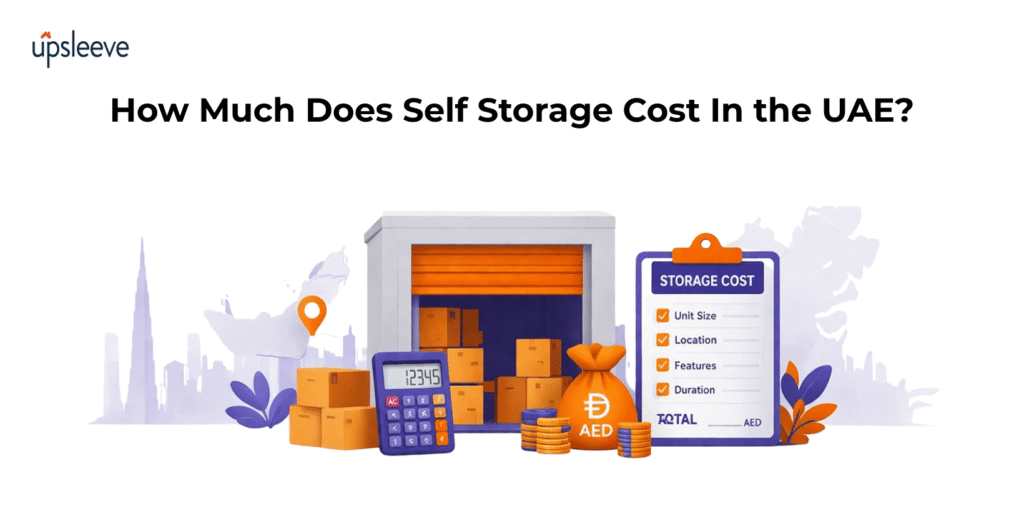
The cost of self-storage in the UAE typically ranges from AED 300 to AED 3,000+ per month, depending on unit size, location, rental duration, and additional features such as security and climate control. Smaller units for personal items are more affordable, while larger units for furniture or business inventory cost more. Self-storage facilities in central urban areas like Dubai and Abu Dhabi tend to charge higher rates compared to units in other emirates. Long-term rentals often come with discounts, whereas short-term or flexible arrangements may be pricier. The monthly rate of these self-storage units may also increase due to extra features like climate-controlled storage and 24/7 access, which can further increase the monthly rate. Residents and businesses should understand all these factors to estimate the average self-storage cost and choose the right unit for their needs.
The table below shows the estimated weekly, monthly, and yearly storage costs in the UAE, along with the items each unit size can store. These values represent common market ranges for self storage UAE, including Dubai storage prices and self-storage Abu Dhabi rates.
| Unit Size (Sq Ft) | Weekly Cost (AED) | Monthly Cost (AED) | Yearly Cost (AED) | Estimated Items Stored |
|---|---|---|---|---|
| 25 (Small) | 75-110 | 300-400 | 3,600-4,800 | Boxes, luggage, books, seasonal items, paperwork |
| 50 (Medium) | 230-325 | 900-1,400 | 10,740-16,800 | Furniture, boxes, and small appliances from a 1-bedroom apartment |
| 75 (Large) | 250-350 | 1,000-1,450 | 12,000-17,400 | Furniture, appliances, and boxes from a 1-2 bedroom apartment |
| 100 (XL) | 430-650 | 1,000-2,000+ | 20,400-31,200 | Full apartment furniture, including beds, sofas, and chairs |
| 150+ (XXL) | 600+ | 2,500-3,000+ | 30,000+ | Contents of 2-3 bedroom homes, business inventory, and large furniture |
Cost of 25 Square Feet Storage Unit
A 25 square feet (5×5 ft) storage unit in the UAE typically costs between AED 300 and AED 400 per month, making it one of the most affordable and practical options for individuals who need compact storage space, with pricing influenced by factors such as location, security features, and climate control availability. This unit size is roughly comparable to a small walk-in closet, making it suitable for storing a limited number of personal belongings without renting unnecessary space. It is commonly used for boxes, luggage, seasonal decorations, books, and important paperwork, making it ideal for people who want to declutter their homes or store extra items safely. This sized storage unit is chosen by small apartment residents, students, and individuals in transition because it provides cost-effective and organized storage while keeping belongings secure and easily accessible.
Cost of 50 Square Feet Storage Unit
A 50 square feet (5×10 ft) storage unit in the UAE typically costs between AED 900 and AED 1,400 per month and offers a practical solution for people who need moderate storage space for household belongings, with pricing influenced by factors such as facility location, security features, and climate control options. This unit size is large enough to store the contents of a small room or a one-bedroom apartment, making it suitable for furniture, packed boxes, and small appliances. Items such as a bed frame, chairs, shelves, luggage, and household cartons can be organized efficiently within the space of the 50 square feet storage unit. A 5×10 ft storage unit balances affordability with storage capacity, making it a popular option for individuals who are moving, renovating, or temporarily storing furniture and personal belongings.
Cost of 75 Square Feet Storage Unit
A 75 square feet (7.5×10 ft) storage unit in the UAE typically costs between AED 1,000 and AED 1,450 per month and provides additional capacity for households that need more room to store furniture and multiple boxes, with pricing depending on factors such as facility location, climate control, and access features. This unit size accommodates the belongings of a 1-to 2-bedroom apartment or small house, making it suitable for storing larger furniture pieces, appliances, and stacked moving boxes. This space can efficiently accommodate and organize items such as sofas, mattresses, wardrobes, dining tables, and packed cartons. A 7.5×10 ft storage unit provides enough space to accommodate bulky household items while remaining more affordable than larger units, making it a practical choice for growing families or individuals managing household moves.
Cost of 100 Square Feet Storage Unit
A 100 square feet (10×10 ft) storage unit in the UAE typically costs between AED 1,000 and AED 2,000+ per month and provides spacious storage suitable for households or businesses that need to store larger volumes of items, with pricing influenced by factors such as facility location, security features, and climate-controlled conditions. This unit size offers enough capacity to store the contents of a full one-bedroom apartment, including large furniture and multiple household items. This space can efficiently accommodate beds, sofas, chairs, cabinets, and packed moving boxes while still allowing for organized storage and easy access. A 10×10 ft storage unit also works well for small business storage, allowing companies to keep extra inventory, office furniture, or equipment without renting a larger warehouse. Mainland businesses licensed by the Dubai Department of Economy and Tourism and free zone e-commerce operators use this size to store seasonal stock and archived records without leasing a full warehouse in JAFZA or DMCC. Most 100 sq ft units in Jebel Ali and Dubai Investment Park are positioned for SME inventory storage, to offer a cost-effective option for light commercial use. This combination of generous storage capacity and flexible use makes this unit size a practical choice for both personal and commercial storage needs.
Cost of 150 Square Feet Storage Unit
A 150 square feet (10×15 ft) storage unit in the UAE typically starts from AED 3,000 or more per month and provides a large and versatile storage solution for households and businesses with substantial storage needs, with final pricing depending on facility location, security features, and climate-controlled options. This unit size offers enough capacity to store the contents of a two to three-bedroom home, making it suitable for large furniture pieces and multiple household items. Beds, sofas, wardrobes, dining tables, appliances, and stacked moving boxes can be arranged efficiently within the space. Businesses also use 10×15 ft storage units to store office furniture, inventory, equipment, and archived documents. Large storage capacity and flexibility make this unit size ideal for long-term storage, bulky household belongings, business inventory, or even small vehicles, providing a practical option for people who require significant storage space.
What Factors Affect the Cost of a Self-Storage Unit?
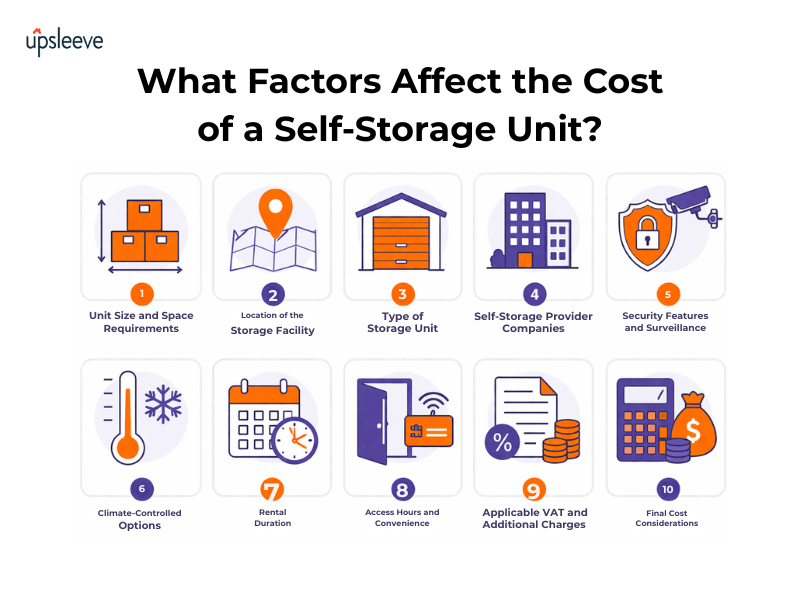
The factors that affect the cost of a self-storage unit are unit size, facility location, storage type, provider quality, security features, climate control, rental duration, access convenience, VAT, and additional service charges. Each of these elements directly influences the final monthly price because they affect the amount of space used, operational costs, security investment, and the level of service provided by the facility.
Some factors that increase the cost of a self-storage unit are given below.
- Unit Size and Space Requirements: Larger self-storage units cost more because they provide additional space and can store bulkier items, such as furniture or the contents of an entire home, while smaller self-strorage units are more affordable and suitable for limited storage needs.
- Location of the Storage Facility: Self-storage unit facilities located in prime or urban areas typically charge higher prices due to higher property costs and stronger demand for convenient access.
- Type of Storage Unit: Locker, small, medium, and large self-storage units vary in price based on their capacity and layout, while specialized options, such as indoor, climate-controlled, or premium-access units, cost more due to enhanced protection, convenience, and accessibility.
- Self-Storage Provider Companies: Well-established self-storage unit providers may charge higher rates because they invest more in facility management, professional service, and reliable infrastructure.
- Security Features and Surveillance: Advanced security features in a self-storage unit, such as CCTV, gated access, PIN codes, and smart locks, raise costs due to installation and ongoing monitoring, but they improve safety by preventing theft and restricting unauthorized access.
- Climate-Controlled Options: Climate-controlled self-storage units cost more because they maintain stable temperature and humidity levels, protecting sensitive items from heat, moisture, and environmental damage.
- Rental Duration: Short-term rentals often have higher monthly rates due to administrative costs and unit turnover, while long-term agreements may offer discounts for extended occupancy.
- Access Hours and Convenience: Self-storage unit facilities offering 24/7 access or extended entry hours charge more because additional security monitoring and operational support are required.
- Applicable Value Added Tax and Additional Charges: Government VAT and extra costs, such as insurance, locks, and service fees, raise the price of a self-storage unit because they cover legal taxes, protection for stored items, and operational services, increasing the total monthly expense.
- 10. Final Cost Considerations: The overall price of self-storage is determined by combining all these factors, including size, location, features, rental terms, and additional services offered by the facility.
1. Unit Size and Space Requirements
Self-storage cost depends largely on unit size, with larger spaces costing more because they occupy more facility space and can store a higher volume of items. Choosing the right self-storage unit size helps avoid paying for unused space. Small units of 10-25 sq ft are best suited for storing boxes, luggage, documents, and seasonal items. A 50 sq ft unit can typically accommodate furniture and boxes from a small room, while 75-100 sq ft units are suitable for the contents of a one-bedroom apartment, including larger furniture and appliances.150+ sq ft units, on the other hand, are designed to store multi-bedroom household contents, office furniture, or business inventory.
Planning a Move? Let the Experts Handle It
From home moves to office relocations, our professional movers ensure safe packing, timely transport, and stress-free moving. Get expert help today.
Get a Free Moving Quote2. Location of the Storage Facility
The location of a storage facility has a direct impact on its cost because prime urban areas have higher real estate prices and greater demand. Dubai Municipality permits self-storage operations only within designated industrial zones, which is why compliant storage facilities are not available in areas such as Downtown Dubai or Dubai Marina. Al Quoz Industrial Areas 1, 2, and 3 host the largest concentration of facilities and typically charge higher rates due to their proximity to central Dubai. In contrast, Dubai Investment Park and Jebel Ali Industrial Area offer lower per-square-foot pricing because of lower land costs and greater distance from the city centre. Ras Al Khor is also a designated warehouse zone under Dubai Municipality jurisdiction, while facilities in Jebel Ali Free Zone operate under Trakhees licensing instead of mainland regulation. Facilities in central locations such as Dubai and Abu Dhabi charge more since land and operational expenses are higher, and customers value the convenience of easy access. Storage units in these areas also offer shorter travel times and better connectivity, which adds to their appeal. Storage facilities in Sharjah, Ajman, or the Northern Emirates, in contrast, are located in less expensive areas with lower demand, allowing providers to offer more affordable rental rates. Customers comparing quotes across different zones normalize pricing by calculating the cost per square foot per month to fairly compare units of different sizes and locations, such as an Al Quoz facility versus a Dubai Investment Park unit.
3. Type of Storage Unit
The type of storage unit affects pricing because larger or specialized units require more space, equipment, and management. Locker units and small units are the most affordable since they are designed for boxes and personal items, requiring minimal space and resources. Medium and large units cost more because they can accommodate furniture, appliances, or business inventory, which demands additional floor space and structural support. Specialized units, such as indoor, climate-controlled, or premium options, have higher rates due to the extra features like temperature and humidity control systems, CCTV surveillance, gated access, alarm systems, on-site staff monitoring, drive-up access, and enhanced lighting, all of which increase operational costs for the facility.
4. Self-Storage Provider Companies
A trusted storage provider may cost more because they invest in security, staff, and facility management, so your belongings are safe and services are reliable. These companies maintain well-managed facilities with access control, CCTV monitoring, and professional customer support, which adds to operational costs but guarantees better protection, service quality, and transparent pricing for customers.
5. Security Features and Surveillance
Storage units with advanced security systems cost more because installing and maintaining equipment like gated access, PIN codes, and smart locks requires significant investment. These systems operate within mandatory regulatory approvals that define what qualifies as a compliant self-storage facility in Dubai. Dubai Civil Defence approval ensures fire safety compliance, including fire alarms, zoned sprinkler systems, and emergency readiness, while Dubai Police approval sets the required CCTV and surveillance standards. These features not only prevent unauthorized entry but also allow facilities to monitor activity, track access logs, and respond quickly to potential security issues. Self-storage facilities with comprehensive surveillance and access control can protect high-value items and sensitive belongings more effectively than standard units, making them a safer option despite the higher rental cost. Self-storage providers factor the cost of these compliance requirements into the monthly rental price.
6. Climate-Controlled Options
Climate-controlled units cost 20-30% higher than standard storage, because they protect belongings from extreme temperatures and humidity. UAE summers push ambient temperatures above 45°C, coastal humidity rises sharply between June and September, and shamal winds drive dust into non-sealed storage areas. Wooden furniture warps, leather cracks, electronics fail, and paper documents deteriorate under these conditions, which makes climate control a practical requirement rather than an upsell for most Dubai customers. These units maintain a consistent temperature between 55 and 80 degrees and control humidity and airflow, preventing damage to sensitive items such as electronics, wooden furniture, documents, and artwork. Climate-controlled facilities run year-round cooling powered by DEWA, and the electricity bill drives most of the 20-30% price premium.
7. Rental Duration
The cost of self-storage varies depending on the rental duration because short-term rentals require more frequent management, turnover, and administrative effort, which increases the monthly rate. Short-term rentals, typically ranging from a week to a few months, offer flexibility but come at a higher monthly rate. Demand for self-storage in the UAE is mainly driven by practical situations such as gaps between Ejari-registered tenancy contracts, mismatched villa handover and lease end dates, student summer breaks, and expats temporarily relocating or travelling out of the country. Dubai operators usually offer flexible contracts of 1 to 3 months to accommodate these needs. Long-term storage, on the other hand, with contracts from 1 month up to 11 months often provides discounts because facilities benefit from guaranteed occupancy, reduced turnover, and lower administrative costs, making it more cost-effective for extended use.
8. Access Hours and Convenience
Storage facilities that provide 24/7 gate access or extended hours, including early morning or late evening entry, charge higher rental rates because additional staffing, security, and operational costs are required to support around-the-clock access. These features allow customers to retrieve or store items at any time, offering flexibility for busy schedules or business operations to provide safe, reliable, and unrestricted access that justifies the slightly higher cost.
9. Applicable VAT and Additional Charges
Additional charges such as VAT, insurance, locks, and service fees raise the overall cost of self-storage because they cover regulatory compliance, risk protection, and facility operations. A 5% VAT is applied to the base rental price as required by UAE VAT law, while optional services like insurance protect belongings against damage or loss, and premium locks enhance security. The UAE Federal Tax Authority (FTA) sets a standard 5% VAT rate, effective from 1 January 2018, which applies to storage services on the mainland. Business customers who reclaim input VAT require a tax invoice prepared in the FTA-prescribed format. Pick-up and delivery fees are also a standard line item on Dubai storage invoices, as most customers store items from high-rise apartments rather than directly accessing ground-level units. Tower buildings in Dubai Marina, Downtown Dubai, Business Bay, and JLT require lift bookings and security deposits, which the mover arranges and then charges back to the client as separate invoice items. These costs directly increase the total storage budget, making it important to account for them when selecting a unit.
10. Insurance and Operator Liability
Self-storage invoices in the UAE include two separate insurance types, including the facility operator insurance (property and public liability insurance) and the customer contents insurance (stored goods protection cover). Facility operator insurance covers the building, fire systems, and general operator liability, while customer contents insurance covers the items stored inside the unit. Standard UAE storage contracts limit operator liability to a fixed amount per unit unless the customer declares a higher value and pays an additional premium. Insurance cover is void if prohibited items are stored, and insurance claims are only valid when the facility maintains active Dubai Municipality and Dubai Civil Defence approvals at the time of the incident.
11. Final Cost Considerations
The total cost of self-storage depends on a combination of factors, including unit size, location, rental duration, accessibility, and additional features such as climate control. Extra charges such value added tax, along with available promotions or discounts, can also affect the overall pricing. Evaluating all these elements together helps customers estimate the true cost and choose a storage solution that fits both their needs and budget.
Why Should You Hire Professional Piano Movers in the UAE?
The cost difference between self-storage and shared storage is that self-storage is more expensive because it provides a private, dedicated unit, full access, and stronger security measures. Shared storage is cheaper as multiple users share the same space, reducing individual costs. This storage option offers lower expenses but comes with less privacy, limited access, and fewer security guarantees compared to the exclusive and secure environment of self-storage.
What Is the Cheapest Way to Store Small Loads in Dubai?
The cheapest way to store small loads in Dubai is to opt for shared storage, rent smaller units, choose facilities in off-prime locations, or commit to long-term plans. Shared storage allows cost-sharing among multiple users, significantly lowering individual expenses. Smaller units, such as 10-25 sq ft lockers, provide just enough space for boxes, luggage, or seasonal items without paying for extra capacity. Facilities outside central areas like Dubai Marina or Downtown Dubai often charge lower rates, and committing to longer rental durations can bring discounts, making storage more affordable for small loads.
Which Items Are Banned from Ordinary Self Storage?
The items that are banned from ordinary self-storage are given below.
- Flammable materials: Fuels, gas canisters, and other highly combustible items are not allowed in ordinary self-storage due to the fire risk they pose.
- Perishable goods: Food, plants, and other items that can spoil or attract pests are prohibited to maintain hygiene and prevent infestations.
- Hazardous substances: Chemicals, toxic materials, and corrosive liquids are banned because they can cause safety hazards and damage to the facility.
- Cash and valuables: Money, jewelry, and other high-value items are generally not permitted as they require higher levels of security than standard storage provides.
- Weapons: Firearms, ammunition, and explosives are strictly prohibited due to strict safety and legal regulations.
Dubai Civil Defence enforces these bans through its Hazardous Substances Control Department. The Dubai Municipality Code of Practice for the Management of Dangerous Goods sets the technical storage standard. Lithium-ion batteries fall under Class 9 dangerous goods classification and require a licensed dangerous-goods warehouse rather than an ordinary self-storage unit.
Which Documents Are Required for Yearly Self Storage?
The documents required for yearly self-storage include a government-issued photo ID, proof of address, a signed rental agreement, emergency contact information, proof of insurance, and a valid payment method. The ID verifies identity, while proof of address confirms residency. The rental agreement specifies unit size, rental duration, access hours, climate control, value-added tax (VAT), and renewal terms. Facilities also require emergency contact details, insurance coverage, and a payment method for automatic charges. Self-storage at move-in requires payment of the first month’s rent and a security deposit, along with a padlock to secure the unit. An inventory list is recommended, and commercial or large-volume rentals may require additional business verification.
Is Climate-Controlled Self Storage Necessary in Dubai?
Yes, climate-controlled self-storage is highly recommended and often necessary in Dubai due to the extreme heat, humidity, and dust that can damage sensitive items. These storage units maintain a consistent temperature and humidity level and offer superior air quality, protecting electronics, wooden furniture, artwork, documents, and other valuable belongings while preserving their condition and lifespan. Facilities like Upsleeve provide climate-controlled storage options across the UAE, ensuring items remain safe and well-maintained despite the harsh local climate.
Learn how much movers cost in the UAE, including pricing factors, apartment size, distance, services included, and tips to plan your moving budget.
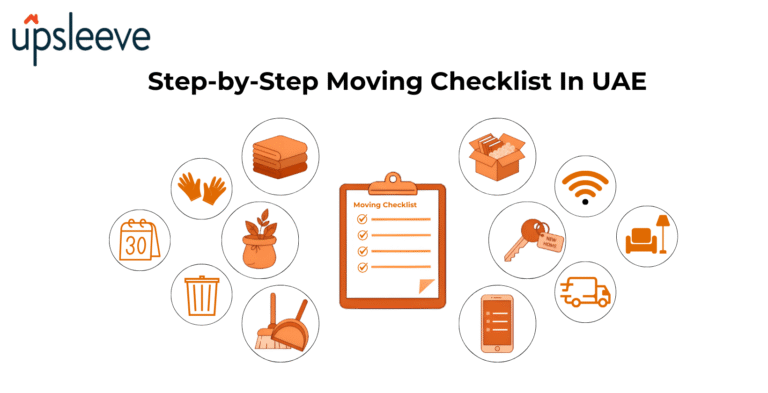
Use a complete moving out checklist to plan, pack, notify utilities, clean, inspect your property, avoid delays, and ensure a smooth, stress-free move.
Learn what relocation means in the UAE, its main types, costs, and a clear step-by-step guide to relocate smoothly with legal, housing, and moving tips.

Discover 12 benefits of hiring professional movers and packers in the UAE, including safe packing, faster moves, cost savings, insurance, and stress-free relocation.
Ready to Move?
Get Your Free Quote
Today
We make moving simple, safe, and stress-free. Our professional team handles everything from packing to delivery with care and precision.
- Professional packing & unpacking services
- Fully insured and licensed movers
- Same-day & next-day availability
- Free, no-obligation estimates
Request a Quote
Fill out the form below and we’ll get back to you as early as possible.