
Learn how much movers cost in the UAE, including pricing factors, apartment size, distance, services included, and tips to plan your moving budget.
Warehouse Relocation: Definition, Types, Process, Challenges, and Tips
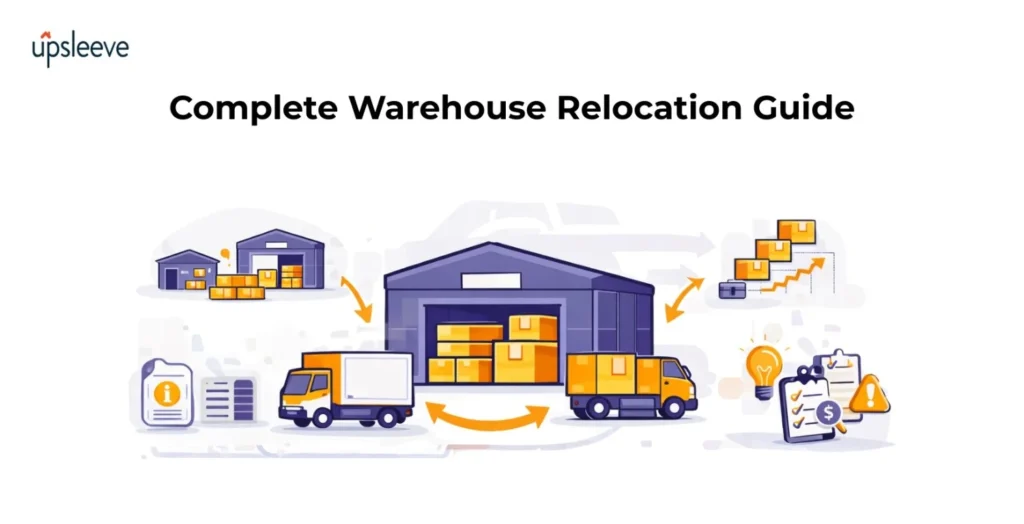
Warehouse relocation involves moving inventory, storage systems, and heavy machinery from one facility to another while maintaining business continuity. Businesses consider warehouse relocation to include improving cost control, expanding storage capacity, optimizing logistics networks, and supporting operational growth. The warehouse relocation process requires careful planning to minimize operational downtime and maintain accurate stock movement during the transition. However, you may face challenges during warehouse relocation that include inventory inaccuracy issues, stock damage during transport, employee safety risks, and disruptions to daily operations. These operational challenges are often compounded by difficulties in load management, timeline management, equipment handling, and coordinating teams while keeping warehouse activities running smoothly. Poor planning leads to operational delays, misplaced inventory, and interruptions that affect overall productivity.
Managing these challenges requires a structured relocation approach, which usually begins with an inventory audit to verify stock levels and identify high-velocity items that require priority handling. You can further increase the efficiency of this relocation process through a warehouse relocation checklist, which helps to organize packing, labeling, equipment dismantling, and transport coordination. A realistic relocation schedule, often including a buffer week, helps control delays and maintain operational stability. Implementing this schedule effectively also requires careful equipment handling, organized stock placement, and system testing after installation in the new facility. Additional best practices, such as clear communication with teams, effective load planning, and continuous monitoring of operations, for a smoother transition and protect inventory throughout the relocation process.
What Is Warehouse Relocation?
Warehouse relocation is the strategic process of moving a warehouse, including its inventory, equipment, shelving, machinery, and logistical systems that support inventory management, order fulfillment, and distribution, from one location to another. The goal of warehouse relocation is to optimize operational efficiency, reduce costs, expand capacity, improve accessibility, or align the warehouse location with evolving business needs. Warehouse relocation, unlike routine inventory movement, is a complex project requiring careful planning, including inventory audits, transportation logistics, staff reallocation, and potential upgrades to the new facility’s infrastructure.
What Are the Types of Warehouse Relocation?
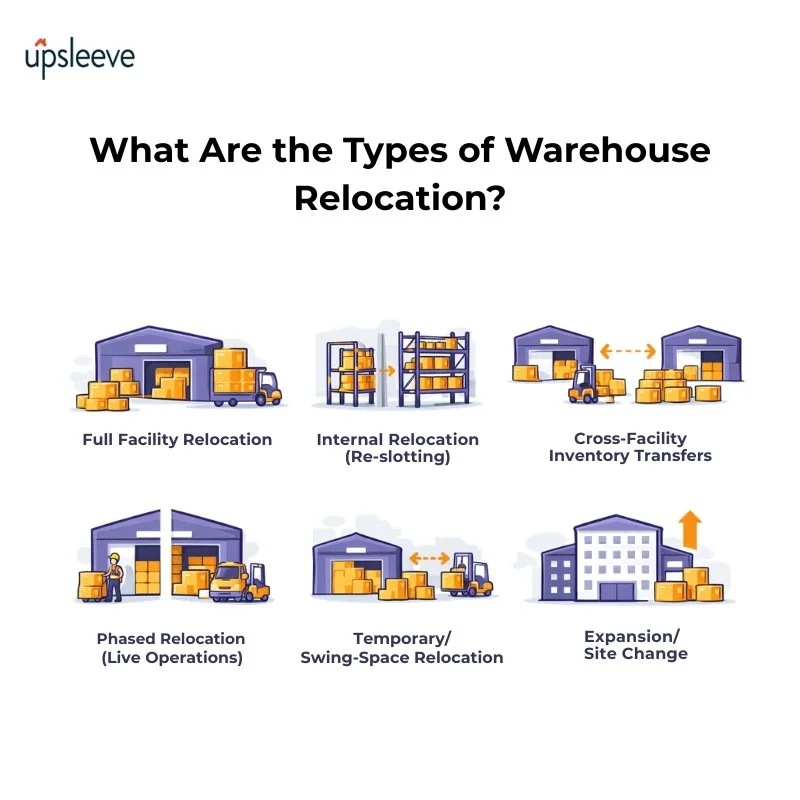
The types of warehouse relocation are full facility relocation, internal relocation (re-slotting), cross-facility inventory transfers, phased relocation (live operations), temporary or swing-space relocation, and expansion or site change. Each type serves a specific purpose depending on the business’s operational needs, growth objectives, or logistical challenges. Full facility relocation moves the entire warehouse to a new site, while internal relocation, or re-slotting, reorganizes inventory within the same facility. Other types include cross-facility inventory transfers to balance stock, phased relocation to move operations in stages, temporary or swing-space relocation during renovations, and expansion or site change to support growth and improve supply chain performance.
Warehouse relocations in the UAE require different approaches depending on whether the move is within mainland industrial areas, between free zones, or across emirates. Mainland industrial hubs in Dubai, including Al Quoz, Ras Al Khor Industrial Area, Al Qusais, Umm Ramool, and Nadd Al Hammar, follow standard commercial access and timing regulations. Free zone relocations involve additional permit requirements and zone-specific protocols at locations such as Jebel Ali Free Zone (JAFZA), Dubai Industrial City, Dubai Investments Park (DIP), and Dubai South near Al Maktoum International Airport. Cross-emirate warehouse moves add another layer of regulatory compliance, particularly for relocations involving SAIF Zone and Hamriyah Free Zone in Sharjah, or KIZAD in Abu Dhabi. Nature of the move changes based on the zones involved, such as a free-zone-to-mainland move, which is treated as an expansion or site change, while relocating within JAFZA is more often handled as a full facility relocation.
Full Facility Relocation
Full facility relocation is a type of warehouse relocation in which the entire warehouse, including inventory, shelving, machinery, equipment, and operational systems, is moved to a new location. This facility relocation makes sure that the warehouse resumes full operations at the new site with minimal downtime. It involves careful planning of logistics, transportation, and scheduling, as well as a complete audit of inventory to account for all items being moved. Companies typically choose full facility relocation when they need to expand, improve supply chain efficiency, or consolidate operations into a more suitable location.
Internal Relocation (Re-slotting)
Internal relocation, also known as re-slotting, refers to the process of reorganizing or moving inventory and materials within the same warehouse rather than transferring them to a new facility. This type of relocation focuses on optimizing space utilization, improving workflow efficiency, and reducing the time and effort required to pick, pack, and ship items. Re-slotting may involve changing the placement of products based on demand, seasonality, or size, as well as adjusting shelving layouts, storage racks, or bin locations.
Cross-Facility Inventory Transfers
Cross-facility inventory transfers involve moving inventory from one warehouse or distribution center to another facility within the same organization. This type of relocation is used to balance stock levels, meet regional demand, reduce shipping times, or optimize supply chain efficiency. Cross-facility inventory transfers, unlike full facility relocation, move only the inventory rather than the entire warehouse infrastructure or equipment. The process requires careful planning, including inventory audits, transportation logistics, and accurate tracking to make sure that stock reaches the destination warehouse safely and is correctly integrated into the receiving facility’s storage and management systems. Cross-facility transfers help businesses maintain inventory flexibility and responsiveness without the complexity of relocating an entire warehouse.
Phased Relocation (Live Operations)
Phased relocation, also known as live operations relocation, is a type of warehouse relocation in which inventory, equipment, and operations are moved to a new facility in stages rather than all at once. This approach allows the warehouse to continue functioning during the relocation, minimizing disruption to business operations and customer fulfillment. Each phase of this relocation involves transferring specific sections of inventory, certain equipment, or particular processes at a time, followed by testing and integration into the new facility before moving to the next phase. Phased relocation requires meticulous planning, coordination, and real-time communication so both the old and new warehouses operate smoothly during the transition. This method is often chosen by businesses that cannot afford extended downtime or service interruptions.
Temporary or Swing-Space Relocation
Temporary or swing-space relocation is a type of warehouse relocation where inventory and operations are moved to a short-term, interim facility while the primary warehouse undergoes renovation, expansion, or repair. This approach makes sure that business operations, such as order fulfillment and inventory management, continue without interruption despite the temporary unavailability of the main warehouse. Swing-space relocation typically involves moving only essential inventory, equipment, and staff needed for ongoing operations, rather than the entire warehouse infrastructure. Operations are moved back, making this approach ideal for businesses needing continuous workflow without permanent relocation once the primary facility is ready.
Planning a Move? Let the Experts Handle It
From home moves to office relocations, our professional movers ensure safe packing, timely transport, and stress-free moving. Get expert help today.
Get a Free Moving QuoteExpansion or Site Change
Expansion or site change is a type of warehouse relocation in which a business moves its operations to a larger or more strategically located facility to accommodate growth, increased inventory, or evolving logistics needs. This approach is driven by the need for more space, better access to transportation networks, or proximity to key markets, unlike other relocation types that may focus on efficiency or temporary adjustments. Expansion or site change typically involves transferring inventory, equipment, and operational systems while also potentially upgrading infrastructure to support higher capacity or advanced warehouse technologies. This type of relocation allows businesses to scale operations, improve supply chain performance, and position themselves for long-term growth.
How to Relocate a Warehouse?
To relocate a warehouse, you need to assess your current setup, plan for future operational needs, and create a detailed relocation checklist. Hire professional movers like Upsleeve to handle equipment, racking, and inventory safely and efficiently, and schedule transportation for stock and materials to minimize downtime. Organize employee shifts to maintain productivity, and prepare your inventory by auditing, labeling, and sorting items for easier transport and setup. Keep key contact information handy to manage logistics, ensure the new facility complies with building regulations, and update your address with customers, vendors, and service providers for a smooth transition.
The step-by-step guide to relocate a warehouse is given below.
- Assess current setup: Review your existing warehouse layout, racking, inventory levels, and workflows to identify what works and what needs improvement.
- Plan for future needs: Consider your company’s growth, increased inventory, automation, or new equipment, so the new space meets long-term requirements.
- Prepare relocation checklist: Create a comprehensive list of tasks, timelines, responsibilities, and resources to keep the move organized and on track.
- Hire a professional moving company: Engage experts in warehouse relocation to handle heavy equipment, racking, and inventory safely and efficiently.
- Schedule move and deliveries: Plan transport of stock, equipment, and materials to avoid operational downtime and coordinate with suppliers and carriers.
- Plan employee shifts: Allocate staff to relocation tasks, order fulfillment, and setup in the new facility to maintain productivity.
- Organize inventory: Audit stock, label sections, and sort items to simplify packing, transport, and reassembly in the new warehouse.
- List key contacts: Keep contact details for suppliers, carriers, utility companies, and service providers handy to manage logistics and resolve issues quickly.
- Verify new building regulations: Make sure compliance with zoning laws, safety codes, and permits to prevent delays or fines at the new location.
- Arrange Utility transfer coordination: Disconnect services at the old site and activate them at the new warehouse through the relevant authority (DEWA, SEWA, ADDC, FEWA) to complete handover and avoid service disruption.
- Load upgrade planning: Apply in advance (such as with DEWA) when installing heavy machinery to prevent setup delays.
- Update address and transfer details: Notify customers, vendors, and service providers of your new address and update records for shipping, billing, and utilities.
- Submit free zone approvals: File move notifications or gate passes through authority portals (JAFZA, DMCC, DAFZA, Dubai South) to secure entry clearance.
- Ensure licence and access compliance: Match driver and vehicle details with security records and update the warehouse licence address so operations can legally resume at the new unit.
You should hire professional warehouse relocation service providers like Upsleeve as they have end-to-end planning, equipment handling, and inventory transport that help businesses move their operations with minimum downtime.
What are the Key Challenges in Warehouse Relocation?
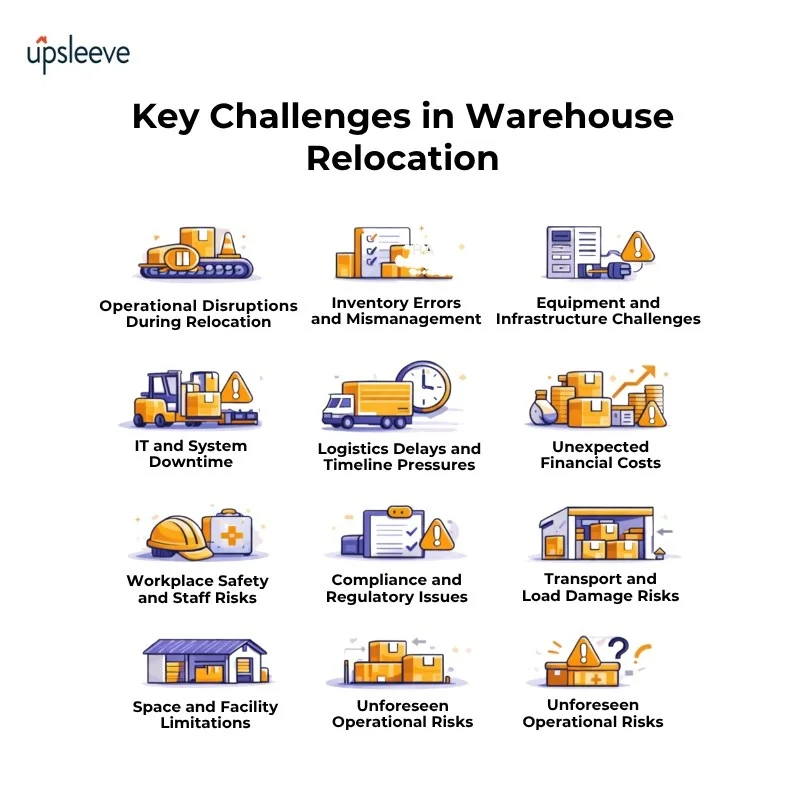
The key challenges in warehouse relocation are operational disruptions, inventory errors and mismanagement, equipment and infrastructure issues, IT and system downtime, and logistics delays and timeline pressures. Some other challenges include unexpected financial costs, workplace safety and staff risks, compliance and regulatory issues, transport and load damage risks, space and facility limitations, and unforeseen operational risks.
Moving a warehouse interrupts daily operations, delaying order fulfillment and affecting the entire supply chain. Inaccurate labeling, improper sorting, or misplacement of stock causes inventory discrepancies during warehouse relocation. These errors slow down operations and lead to lost or damaged products. Warehouse infrastructure and equipment, including heavy machinery, racking systems, and conveyors, are particularly vulnerable during transport, and any damage or improper reassembly can be costly while causing further delays. Relocating servers, scanners, and other warehouse technology disrupts tracking systems, order processing, and communication, affecting operational efficiency. Relocation logistics of the warehouse, including tight schedules, overlapping tasks, and coordination with movers, carriers, and internal teams, often create bottlenecks. Transport and setup delays can cascade across operations, increasing labor costs and placing additional strain on warehouse workflows during the move.
1. Operational Disruptions During Relocation
Operational stability often becomes the biggest concern during a warehouse relocation because daily logistics operations rely on continuous movement, system access, and coordinated workflows. Shifting inventory, equipment, and staff between facilities creates downtime, slowing or temporarily halting key processes like inventory receiving, order picking, packing, shipping, stock replenishment, and real-time inventory tracking. These interruptions often lead to order fulfillment delays during the warehouse move. Inventory may be in transit or stored in temporary locations during the warehouse relocation, making it harder for staff to locate products and process orders efficiently.
Businesses may also experience revenue loss as shipping capacity drops, as fewer orders are processed, which leads to reduced daily sales and lower operational output. These operational slowdowns directly impact clients, as delayed shipments may reduce customer satisfaction and erode trust in the reliability of the service.
2. Inventory Errors and Mismanagement
Inventory errors are a common challenge during warehouse relocation because large volumes of stock are packed, transported, and reorganized within a short period. High product movement during the transition increases the risk of misplaced items, incorrect labeling, and data entry mistakes. These disruptions often lead to inventory inaccuracy, making it harder for teams to track actual stock levels during the warehouse move.
Studies show that warehouse inventory records are inaccurate by as much as 62.3% in poorly managed environments, which further complicates inventory control during warehouse relocation. Frequent handling of goods during the warehouse move also increases the risk of stock damage due to repeated loading, unloading, and inadequate protection. This type of relocation also causes inventory levels to fluctuate if delays occur in scanning, recording, or updating stock movements within warehouse systems.
3. Equipment and Infrastructure Challenges
Warehouse relocation involves moving heavy machinery, racking systems, conveyors, and other infrastructure. This process introduces significant risks, including bent or collapsed racks, damaged conveyor belts, malfunctioning forklifts, and broken automated sorting equipment. Such damage is costly to repair and may cause operational delays. Safety hazards also increase during warehouse relocation, as workers handling large racks, moving conveyors, or operating heavy machinery in tight or unfamiliar spaces face risks such as collisions, crushing injuries, and falls. Warehouse relocation further disrupts automation systems, since conveyors, sorting machines, and automated storage systems often require recalibration or reinstallation. This is because any misalignment of these machines or systems slows workflow once the warehouse becomes operational.
4. IT and System Downtime
Warehouse relocation often requires transferring WMS (Warehouse Management Systems), scanners, networks, and other IT infrastructure, which introduces risks such as data loss, system downtime, and misalignment. Any interruption in these systems disrupts inventory tracking, order processing, and overall warehouse operations. Improper handling or lack of preparation causes misconfigured systems, leading to errors in stock levels, misplaced orders, or delayed shipments.
5. Logistics Delays and Timeline Pressures
Coordinating a warehouse relocation on a tight timeline introduces risks, such as overlapping tasks and compressed schedules, which lead to missed deadlines and rushed decisions. Underestimating time for packing, transporting, and reorganizing inventory often causes bottlenecks, slowing the overall warehouse relocation process. Poor coordination between teams, contractors, and vendors in warehouse relocation further exacerbates these delays, increasing labor costs and the risk of errors. Timeline pressure also disrupts the broader supply chain, delaying shipments, affecting customer orders, and creating operational strain across multiple departments during a warehouse move.
6. Unexpected Financial Costs
Warehouse relocation carries the risk of high and often unexpected financial costs because moving an entire facility involves more than just transporting inventory. Expenses for hiring labor, moving heavy machinery, and handling racking and automation systems quickly exceed initial projections, creating budget overruns. Additional costs arise from downtime, which reduces operational output during the transition, and from repairs or replacement of damaged equipment caused by the warehouse move.
Moving, packing, and storage invoices in the UAE carry 5% VAT under the Federal Tax Authority, which applies to the total service fee quoted by the mover. A warehouse move from a free zone like JAFZA (Jebel Ali Free Zone Authority) to the Dubai mainland also triggers Dubai Customs treatment, because goods leaving the free zone enter the mainland customs territory. Dubai Customs requires a bill of entry for inventory and machinery crossing this boundary, and import duty applies on the declared value at the standard GCC rate. Customers should confirm the current duty treatment and any deposit or refund mechanism with Dubai Customs or a licensed clearing agent before the move, because the financial exposure depends on the goods and the destination.
7. Workplace Safety and Staff Risks
Warehouse relocation increases the risk of hazardous situations as staff handle heavy loads, machinery, and large racks in a new or unfamiliar environment. This is because tight spaces, uneven flooring, and moving equipment create opportunities for slips, falls, and other injuries. Poor communication and unclear task assignments can also weaken employee morale, leaving staff stressed, overworked, or uncertain about safety procedures during the warehouse move. Lack of proper training for warehouse staff and equipment operators further increases the risk of accidents and lowers overall productivity throughout the relocation process.
8. Compliance and Regulatory Issues
Warehouse relocation requires strict adherence to permits, local laws, zoning regulations, and safety codes in the new facility. Failure to comply with these requirements delays the move, prevents operations from starting on schedule, or even results in fines and forced shutdowns. Non-compliance may occur if necessary inspections are overlooked, safety standards are not met, or zoning restrictions are ignored.
UAE compliance also covers the transport leg of the warehouse move, not only the destination facility. The Roads and Transport Authority (RTA) in Dubai regulates heavy vehicle movement, including approved routes, operating hours, and permits for oversized or abnormal loads such as long racking sections and industrial machinery. Sharjah roads fall under the Sharjah Roads and Transport Authority (SRTA), and Abu Dhabi roads fall under the Integrated Transport Centre (ITC). A mover transporting racking, forklifts, or conveyor systems in the UAE should confirm route, time, and load-size permissions with the relevant authority before dispatch to avoid fines and detainment of vehicles.
9. Transport and Load Damage Risks
Improper planning or coordination during transport increases risks during warehouse relocation, including product damage, vehicle accidents, equipment failure, and shipment delays. Unsecured or uneven loads during loading or transit damage products, cause accidents, and strain or damage transport equipment. These issues lead to shipment delays, disrupting order fulfillment and affecting customer deliveries and supply chain schedules.
10. Space and Facility Limitations
Warehouse relocation exposes space and facility limitations that reduce operational efficiency. Limited floor space, insufficient storage capacity, or poorly designed layouts may require significant layout adaptation to accommodate inventory, racking, and equipment. Docking constraints, narrow aisles, or inadequate power supply for machinery and automation systems create post-move problems, slowing order processing and reducing productivity.
11. Unforeseen Operational Risks
Warehouse relocation is disrupted by unforeseen operational risks such as equipment failure, severe weather, or delays from suppliers. Equipment breakdowns, like malfunctioning forklifts or damaged conveyors, halt key operations, while storms, heavy rain, or other weather events delay transport, loading, and unloading of inventory. Supplier delays may prevent critical materials, packaging, or equipment from arriving on schedule, further complicating the move. These unexpected issues escalate quickly, causing shipment delays, extended downtime, and increased costs.
UAE weather and the annual calendar place practical constraints on every outdoor stage of a warehouse move. The Ministry of Human Resources and Emiratisation (MoHRE) enforces a federal midday break from 12:30 PM to 3:00 PM between 15 June and 15 September, during which outdoor work under direct sunlight is not allowed. This reduces the available loading and unloading window during the summer months, because high temperatures often exceed 45°C and can affect temperature-sensitive inventory and electronics during transit, so customers should plan to move such items during early morning or evening hours. Ramadan introduces shorter working days and adjusted shift patterns for warehouse staff and moving crews, so it is important to factor these changes into your relocation schedule to avoid delays.
Upsleeve minimizes operational disruptions during warehouse relocations by implementing phased moves and carefully scheduling critical workflows. Detailed audits and real-time stock tracking help them prevent inventory errors while supervising loading and unloading efficiently. Heavy machinery and racking systems are handled safely using specialized equipment and trained staff for dismantling, transport, and reassembly. Transportation and team coordination are optimized through route planning, dedicated movers, and continuous monitoring to avoid delays. Pre-move IT testing and setup make sure that warehouse management systems remain functional, keeping operations accurate and on schedule throughout the relocation.
What are the Essential Tips for a Successful Warehouse Move?
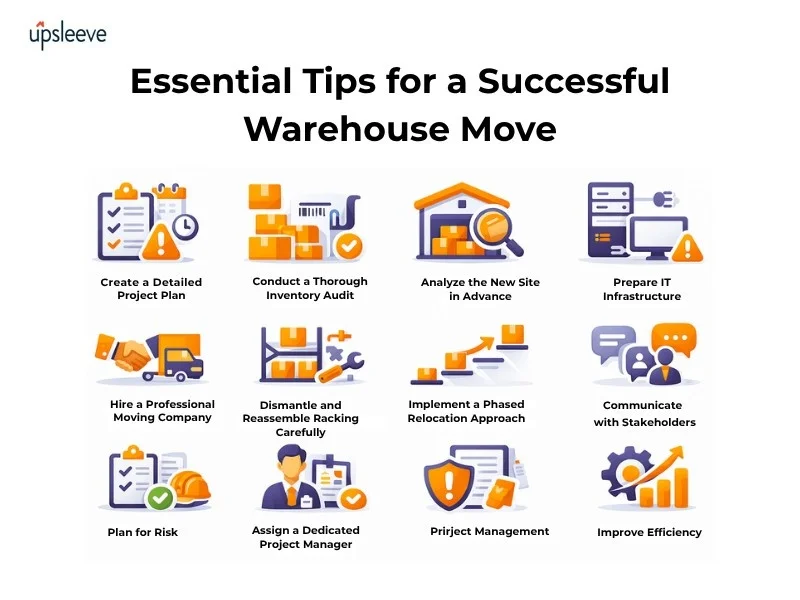
The essential tips for a successful warehouse move are to create a detailed project plan, conduct a thorough inventory audit, analyze the new site in advance, prepare the IT infrastructure, and hire a professional moving company. Additional tips for an efficient relocation include dismantling and reassembling racking carefully, implementing a phased relocation approach, communicating with stakeholders, ensuring safety compliance, assigning a dedicated project manager, planning for risk management, and improving overall efficiency.
The necessary tips for a successful warehouse move are given below.
1. Create a Detailed Project Plan
Make a detailed project plan to keep your warehouse relocation organized and on track. Your warehouse relocation plan should include a clear timeline and a breakdown of all tasks, from packing inventory to setting up equipment in the new facility, with responsibilities assigned to staff so nothing falls through the cracks. You should divide the move into phases and milestones because it breaks the relocation into manageable sections and highlights key achievements along the way. This approach gives you a clear view of progress and helps guide your team through important steps, such as completing racking installation or bringing automation systems online. You should also include a buffer week to add flexibility for unexpected delays, which are almost inevitable during a warehouse relocation. A well-structured roadmap makes sure your team always knows what needs to happen, when, and who is responsible, keeping the move organized, controlled, and much less stressful.
2. Conduct a Thorough Inventory Audit
Conduct a thorough inventory audit and organize stock into clearly labeled sections. You should then sort items to separate dead stock, damaged goods, or slow-moving products. Unneeded items are set aside for disposal or sale to free up space. Record the remaining inventory are maintained to track items during transit and guide placement in the new warehouse.
3. Analyze the New Site in Advance
Walk through your new warehouse to assess the space for daily operations. Inventory placement indicates where everything will go and how staff and equipment will move. Review the layout and racking plan so it fits efficiently. Traffic flow, forklift access, delivery truck areas, zoning, and safety rules must be checked carefully. Finalize the main layout and racking, then place utilities, workstations, and smaller storage areas.
Verify that the destination facility has all required approvals in place before moving into a new warehouse in the UAE, because moving operations cannot legally resume without them. Dubai Civil Defence must sign off on fire-safety compliance, including alarm systems, sprinklers, and high-rack storage configurations. Dubai Municipality issues general warehouse approvals for mainland locations, while Trakhees handles environment, health, and safety (EHS) approvals for warehouses within Ports, Customs, and Free Zone Corporation areas like JAFZA. You should also ensure that all heavy racking installation and lifting operations are certified by an accredited third-party inspection body before use, so the facility meets safety requirements before going live.
4. Prepare IT Infrastructure
Set up your IT infrastructure well before the move to keep your WMS, scanners, and networks running smoothly and minimize downtime. Backups of all critical data must be created, and systems should be securely disconnected from the current warehouse to prevent data loss during relocation. Plan the placement of servers, workstations, and network equipment in the new facility, and verify that RFID, barcoding, and scanning systems are ready to go.
5. Hire a Professional Moving Company
Hire a professional moving company for your warehouse relocation. Provide them with a detailed inventory list and layout of your current warehouse. You should schedule the move in stages, starting with large equipment and racking, then inventory. Assign your team to guide movers, label items, and check off everything as it’s loaded. Set up a clear plan for unloading and placing items in the new warehouse so everything ends up in the right spot.
Selecting a compliant UAE mover is one of the most important steps for a successful warehouse move, as it helps reduce operational risks and legal exposure. Confirm if the mover holds a valid trade licence covering moving, storage, or logistics activities, and that its packing and loading teams are properly sponsored under MoHRE work permits with valid residency visas. You should also check that the company carries goods-in-transit and public liability insurance to protect your inventory and equipment throughout packing, loading, transport, and unloading. Forklift operators and riggers should handle heavy items such as racking and machinery to ensure safe and controlled movement throughout the relocation process. Professional moving companies like Upsleeve meet these requirements for UAE warehouse relocations.
6. Dismantle and Reassemble Racking Carefully
Start by removing all your inventory from the racks and labeling each section or beam. Disassembly of racking should be done systematically from the top down, with bolts, connectors, and small parts sorted into labeled containers. Use tools like wrenches, socket sets, and levels, and wear gloves and hard hats for safety. You can move racking components to the new warehouse using lifts or pallet jacks for heavy beams. Lay out the parts in the order you will reassemble them, keeping your tools nearby. You can now reassemble each rack according to the original or updated layout, making sure every piece is level and secure.
7. Implement a Phased Relocation Approach
Consider moving your warehouse in phases to keep operations running smoothly and reduce disruption. Start with low-priority stock or areas that are not critical to daily operations, allowing your team to test processes and work out any issues before moving high-demand sections. You should move high-velocity items, such as fast-selling products, critical inventory, or frequently picked stock last, to keep them accessible and organized until they are placed in the new warehouse.
8. Communicate with Stakeholders
Communicate with your team throughout the warehouse relocation to coordinate tasks and reduce confusion. Employee updates should be provided regularly to clarify responsibilities and workflow. Suppliers, carriers, utility companies, and the post office must be notified about the move to maintain deliveries, shipments, and services. Update your customers with changes in order fulfillment and share relevant information for inquiries. Coordinate with all stakeholders by assigning responsibilities, holding briefings, and sharing progress reports to track tasks and manage workflow throughout the move.
9. Ensure Safety Compliance
Follow all safety standards during your warehouse relocation to protect workers and maintain smooth operations. You should conduct risk assessments at both warehouse sites before starting, and make sure your team receives manual handling training for moving heavy equipment and racks. Use the proper protective equipment, such as gloves, helmets, and safety shoes, during dismantling, installation, and transport of inventory and machinery.
10. Assign a Dedicated Project Manager
Assign a dedicated project manager by selecting someone with experience in logistics or warehouse operations and clearly defining their responsibilities for the relocation. The project manager should be given authority to coordinate teams, monitor progress, and allocate resources throughout the move. Set up regular check-ins, such as daily calls or briefings, so you can address issues quickly and maintain clear communication across departments.
11. Plan for Risk Management
Identify potential risks such as transport delays, equipment failure, or staffing shortages early in your warehouse relocation to reduce their impact on operations. Risk assessment involves evaluating each scenario to determine how it could affect timelines, costs, and operations. Develop contingency plans by arranging backup transport, preparing spare equipment, and scheduling additional staff for critical tasks. You should review and update these plans regularly throughout the move to respond quickly to delays or disruptions in the warehouse relocation process.
12. Improve Efficiency
Arrange storage, racking, and workstations based on workflow, grouping frequently picked items close to packing areas and creating clear pathways for forklifts and staff. You can plan traffic flow by mapping routes for receiving, picking, and shipping to avoid congestion. Set up workstations and packing areas logically so tools and supplies are within reach, and adjust placements as needed during the move.
How to Manage Inventory During Warehouse Relocation?
To manage inventory during warehouse relocation, start with a thorough inventory audit to identify dead stock, damaged goods, and slow-moving items. Inventory should be clearly labeled and organized so that everything has a designated place during the move. Stock can be arranged by priority, with low-priority items moved first while high-velocity items remain accessible until the final stages to maintain smooth order fulfillment. Each item should be tracked carefully using barcoding or RFID systems, and records must be maintained accurately throughout transit and reassembly. This level of planning and organization helps reduce errors, prevent loss, and ensures stock remains accurate and ready in the new warehouse.
How to Relocate a Warehouse Without Disrupting Operations?
To relocate a warehouse without disrupting operations, follow the tips given below.
- Define duties and communication channels: Clearly assign responsibilities to team members and establish how updates and issues will be communicated.
- Plan the move during off-peak hours or weekends: Schedule relocation tasks when order volume is low to minimize impact on day-to-day operations.
- Schedule orientation shifts at the new site: Give staff time to familiarize themselves with the new layout, equipment, and workflows before full operations begin.
- Form a relocation team with key department representatives: Include leaders from operations, inventory, IT, and logistics to coordinate tasks, troubleshoot issues, and keep the move on track.
What Are the Main Transportation Issues in Warehouse Relocation?
The main transportation issues in warehouse relocation are given below.
- Flat-tire issues: Vehicle breakdowns delay shipments and require backup transportation plans.
- Lost shipments: Misplaced or misrouted inventory creates stock gaps and disrupts operations in warehouse relocation.
- Highway traffic delays: Congestion or accidents on transport routes impact delivery schedules.
- Inefficient loading/unloading: Poorly organized loading docks or unplanned procedures slow down the move.
- Limited real-time visibility: In-transit shipments lacking real-time visibility make it difficult to monitor progress and respond to delays.
- Dock delays: Waiting for loading or unloading at either the old or new warehouse creates bottlenecks during a warehouse move.
- Inbound load management: Mismanagement of incoming shipments causes overstocking, misplacement, or delays in warehouse setup.
- Accurate outbound order processing: Outbound order processing errors during relocation can lead to incorrect shipments reaching customers.
What Are the 7S Rules in a Warehouse?
The 7S rules in a warehouse are Sort, Set in Order, Shine, Standardize, Sustain, Safety, and Security. Sort involves removing unnecessary items and keeping only what is needed to make operations more efficient. Set in Order focuses on arranging tools, inventory, and equipment logically so that everything is easy to find and the workflow is smooth. Shine emphasizes keeping the warehouse clean and organized to prevent accidents and maintain productivity. Standardize creates consistent procedures for labeling, storage, and daily tasks, while Sustain encourages following these practices continuously and refining them over time. Safety covers protocols to protect workers and equipment, and Security addresses safeguarding inventory, machinery, and sensitive data from theft or damage. Following the 7S rules helps your warehouse run smoothly, reduces errors, and supports reliable day-to-day operations.
Related Articles
Use a complete moving out checklist to plan, pack, notify utilities, clean, inspect your property, avoid delays, and ensure a smooth, stress-free move.
Learn what relocation means in the UAE, its main types, costs, and a clear step-by-step guide to relocate smoothly with legal, housing, and moving tips.

Discover 12 benefits of hiring professional movers and packers in the UAE, including safe packing, faster moves, cost savings, insurance, and stress-free relocation.
Ready to Move?
Get Your Free Quote
Today
We make moving simple, safe, and stress-free. Our professional team handles everything from packing to delivery with care and precision.
- Professional packing & unpacking services
- Fully insured and licensed movers
- Same-day & next-day availability
- Free, no-obligation estimates
Request a Quote
Fill out the form below and we’ll get back to you as early as possible.