
Learn how much movers cost in the UAE, including pricing factors, apartment size, distance, services included, and tips to plan your moving budget.
Sea Freight vs Air Freight: Which Shipping Method Is Right for You?
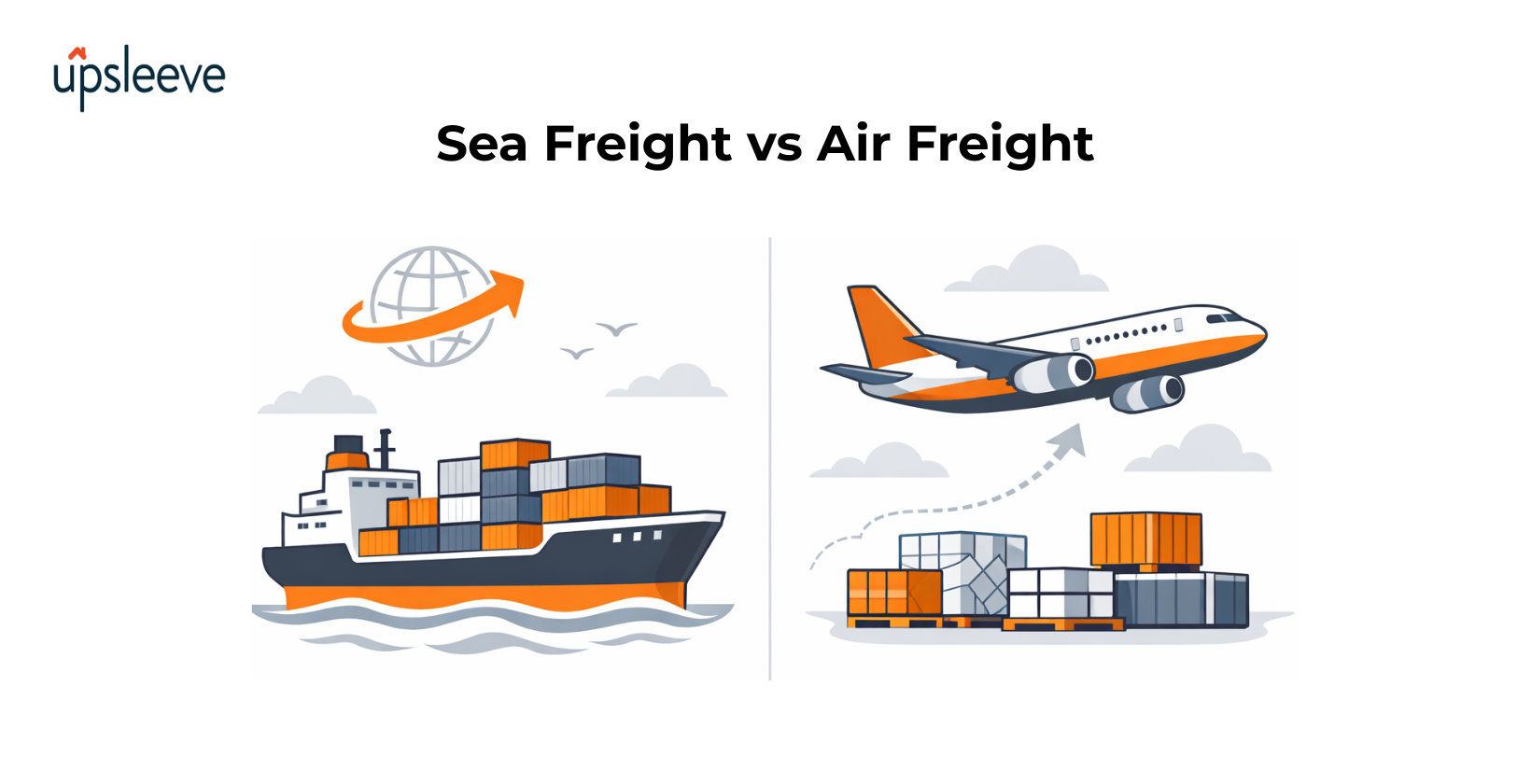
Sea freight and air freight are two different types of freight services. Sea freight moves goods in large volumes along established shipping routes, ideal for transporting bulk or heavy cargo across oceans. Air freight carries shipments through airports and flight networks, designed for fast, time-sensitive deliveries that require speed and precision. Each freight method offers advantages suited to particular shipment types and operational needs. Sea freight provides cost efficiency, large-volume capacity, and a lower environmental impact, while air freight delivers speed, high-value cargo safety, and global accessibility.
Sea freight and air freight are different mainly in cost efficiency, transit speed, cargo capacity, types of goods handled, security measures, environmental impact, and accessibility. Sea freight is ideal for bulky, non-urgent, or hazardous cargo with lower carbon emissions, while air freight offers rapid delivery for high-value shipments and perishable goods through accurate scheduling and more global reach.
Shippers, importers, and exporters need to understand the differences to optimize costs, meet delivery timelines, and maintain cargo safety. They can make informed decisions based on this knowledge for smooth logistics, avoiding delays, and aligning transport choices with business priorities.
What Is Sea Freight?
Sea freight is the international shipping of goods using cargo ships to transport large or heavy consignments across oceans and ports. This moving method provides a cost-efficient solution for UAE movers and businesses who need to ship bulk items, vehicles, or household goods over long distances.
Sea freight in the UAE operates through 5 main port gateways, each serving distinct emirates and trade zones. Jebel Ali Port in Dubai, operated by DP World, is the largest container port in the Middle East and the primary gateway for shipments bound for Dubai and the Northern Emirates. Khalifa Port in Abu Dhabi, operated by AD Ports Group, serves the Khalifa Economic Zone (KEZAD) and handles cargo for Abu Dhabi and Al Ain. Port Khalid in Sharjah, Khor Fakkan Port, and Fujairah Port extend sea freight coverage across the Northern Emirates and the Gulf of Oman. Port Rashid in Dubai serves mainly cruise traffic and niche cargo. Containerized transport across these gateways reduces shipping costs per cubic meter and maintains secure cargo handling for both residential and commercial relocations. This freight method also supports global trade by helping UAE businesses and international shippers move large volumes of goods across continents.
What Is Air Freight?
Air freight is the international shipping of goods using cargo airplanes to transport lighter or time-sensitive consignments quickly across countries and continents. This shipping method provides UAE movers and businesses with a fast and reliable solution for transporting high-value items like documents, essential household goods, and medicine that require urgent delivery.
Air freight companies offer accurate timing, efficient tracking, and secure management of shipments for residential and commercial relocations across Dubai, Abu Dhabi, and other UAE hubs, using scheduled cargo flights and professional airport handling services. This freight method is more expensive than sea freight because of higher fuel costs, airport fees, and fast handling requirements. It is ideal for perishable items like flowers, medicine, and food items, while UAE movers and businesses can save costs by choosing alternative transport for non-urgent deliveries.
What Are the Key Differences Between Sea Freight and Air Freight?
The key differences between sea freight and air freight lie in their cost comparison, transit time and speed, cargo capacity and volume limits, type of goods and restrictions, safety and handling, environmental impact, and global reach and accessibility. Sea freight is more cost‑effective with high volume capacity but slower and limited by ports, while air freight offers faster delivery, wider global access, and stricter handling for high-value or time-sensitive goods.
The differences between sea and air freight are given in the table below.
Factor | Sea Freight | Air Freight |
Cost | Lower cost per kg; AED 1,000 for a standard shipment | Higher cost per kg; same shipment costs around AED 12,000 |
Transit Time | 18 to 30 days for standard FCL; up to 6 weeks for long-haul routes | 1 to 5 days from UAE airports (DXB, DWC, AUH, SHJ) |
Cargo Capacity | Very high; a single cargo ship carries thousands of tons, including FCL and bulk shipments | Limited; strict weight and volume restrictions, even on large aircraft like Boeing 747 freighters |
Cargo Types | Industrial machinery, vehicles, furniture, flammable liquids, corrosive substances (IMDG-compliant) | Electronics, pharmaceuticals, luxury items, fresh food, medical supplies |
Safety & Security | Multiple handling points at ports; exposed to humidity, weather, and rough seas | Controlled airport facilities, dedicated cargo teams, and continuous electronic tracking |
Environmental Impact | 10 to 40 g CO₂ per ton-km | ~500 g CO₂ per ton-km |
Global Reach | Limited to port-connected routes; inland delivery requires road or rail transport | Direct access to most international airports from DXB, DWC, AUH, and SHJ |
Customs Clearance | Processed via Mirsal 2 (Dubai Customs); longer port clearance timelines | Faster clearance at UAE air cargo terminals via Mirsal 2 |
Cost Comparison
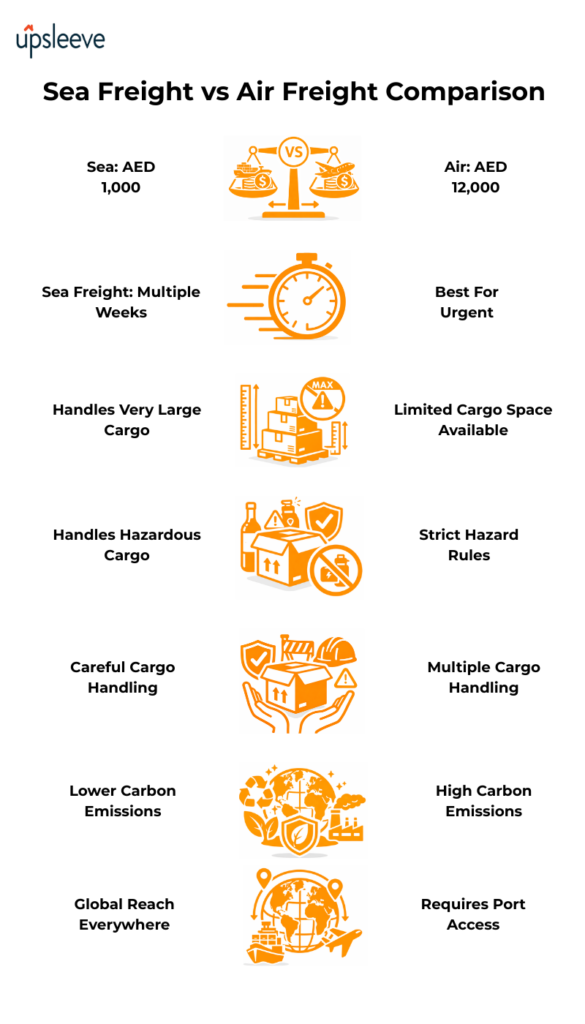
Sea freight is significantly cheaper than air freight because of lower fuel costs, port fees, and slower handling requirements, which makes it ideal for large volumes and non-urgent shipments such as furniture, vehicles, or office equipment. Air freight comes at a much higher cost due to fuel, airport fees, and rapid handling requirements, so it is good for high-value, urgent, or perishable cargo such as electronics, luxury items, medical supplies, or fresh food. A shipment, for instance, costing AED 1,000 by sea could cost around AED 12,000 if transported by air.
UAE VAT treatment directly affects the final invoiced cost of both sea and air freight. The UAE Federal Tax Authority (FTA) zero-rates the international leg of sea and air freight under Article 45 of Federal Decree-Law No. 8 of 2017 on Value Added Tax. The domestic leg from a UAE port or airport to the final delivery address attracts the standard 5% VAT. Zero-rating applies only when the freight provider retains official evidence of international movement, such as a Bill of Lading, Air Waybill, or a customs exit or entry certificate.
Free zone routing reduces the total cost of sea and air freight for businesses importing large volumes into the UAE. Goods imported into free zones such as Jebel Ali Free Zone (JAFZA), Dubai Airport Free Zone (DAFZA), or Khalifa Industrial Zone Abu Dhabi (KIZAD) are exempt from the 5% customs duty until they move into the mainland. Mainland importers pay 5% customs duty on the CIF (cost, insurance, and freight) value at the point of entry, making free zone routing a direct cost advantage for high-volume shippers.
Transit Time and Speed
Sea freight takes around 18 to 30 days for standard full-container shipments, and this time duration can reach up to 4 to 6 weeks for long‑haul ocean journeys, depending on the route. This slower transit time means that sea freight is suitable for planned, non‑urgent shipments, while following schedule certainty and departure frequency is important for UAE movers to avoid delays at Jebel Ali, Khalifa Port, or other UAE gateways.
Air freight delivers goods within 1 to 5 days from UAE airports, including Dubai International (DXB), Al Maktoum International (DWC) in Dubai South, Abu Dhabi International (AUH), and Sharjah International (SHJ), to major global destinations. This transit speed makes air freight the faster option for urgent or time-sensitive shipments where sea freight timelines are not viable. DWC’s location adjacent to Jebel Ali Port shortens the sea-air transfer window for shippers switching between modes on the same consignment, reducing total transit time further. Flight schedules and customs clearance at UAE airports determine the final delivery timeline, making advance planning a necessary step for consistent air freight delivery.
Cargo Capacity and Volume Limits
Sea freight can handle very large cargo volumes, including full-container loads (FCL) or bulk shipments with a single cargo ship carrying thousands of tons across oceans. Air freight has limited cargo space and strict weight restrictions, which make it suitable only for lighter, high-value goods such as electronics, medical supplies, or luxury items. Even large aircraft like a Boeing 747 freighter cannot match the cargo volume of a single container ship, highlighting the limitations of air freight for transporting bulky or heavy shipments.
Type of Goods and Restrictions
Sea freight can carry large or hazardous goods, including industrial machinery, vehicles, flammable liquids, and corrosive substances, though highly regulated items such as explosives, radioactive materials, and paint thinners require IMDG/IMO-compliant packaging and permits before shipment. Air freight has strict restrictions on hazardous items such as flammable liquids, toxic chemicals, or pressurized gases, making it suitable mainly for lighter, high-value, or perishable goods like electronics, pharmaceuticals, fresh flowers, or gourmet food.
UAE import restrictions narrow the range of goods permitted through both sea and air freight gateways. The GCC Common Customs Law prohibits narcotics, gambling equipment, used or reconditioned tyres, nylon fishing nets, live swine, and any material contradicting Islamic faith and public morals. Pork products and non-Halal meat are restricted to licensed importers only. Restricted categories require prior approval from the relevant UAE authority before goods arrive at Jebel Ali, Khalifa Port, or a UAE airport. Medicines require clearance from the Ministry of Health and Prevention (MOHAP), plants and seeds from the Ministry of Climate Change and Environment (MOCCAE), firearms from the Ministry of Interior, and satellite phones or drones from the Telecommunications and Digital Government Regulatory Authority (TDRA). UAE movers and shippers declare restricted items in advance and secure all approvals before shipment departure.
Planning a Move? Let the Experts Handle It
From home moves to office relocations, our professional movers ensure safe packing, timely transport, and stress-free moving. Get expert help today.
Get a Free Moving QuoteSafety, Security, and Handling
Sea freight is less secure for high-value items because it involves multiple handlings during loading, unloading, and transshipment at ports, exposing cargo to potential weather risks, humidity, and rough seas.
UAE-specific conditions between June and September add direct safety and handling risks to sea freight shipments. High ambient temperatures inside standard dry containers affect electronics, artwork, candles, and other heat-sensitive items during loading, storage, and inland transit. Reefer (refrigerated) containers at Jebel Ali and Khalifa Port protect temperature-sensitive cargo, while desiccant and vacuum packing reduce humidity damage on long ocean routes through the Arabian Gulf. Ramadan working hours and UAE public holidays shorten daily port and warehouse handling windows, reducing the time available for safe cargo processing and inspection.
Careful planning and proper containerization protect cargo during sea freight handling. Air freight provides higher security through controlled airport facilities, dedicated cargo handling teams, and continuous tracking via electronic monitoring systems, minimizing theft and damage risks.
Cargo insurance covers residual safety and handling risks on both sea and air freight modes. Sea shipments are covered under Marine Cargo Insurance using Institute Cargo Clauses A, B, or C, while air shipments are covered under All Risk Air Cargo Insurance. Licensed UAE freight forwarders carry Freight Forwarder Legal Liability (FFL) cover, protecting customers against loss, damage, or mishandling during the forwarder’s period of responsibility. Cargo insurers in the UAE operate under the supervision of the Central Bank of the UAE, which took over insurance regulation from the former Insurance Authority in 2020.
Environmental Impact (Carbon Footprint)
Sea freight produces a much smaller carbon footprint from 10 to 40 g CO₂ per ton-km, which makes it a sustainable option for UAE movers and businesses shipping bulk cargo across Dubai, Abu Dhabi, and other ports. Air freight generates approximately 500 g CO₂ per ton-km due to fuel-intensive aircraft operations and rapid handling requirements. Both methods have their pros and cons, but businesses should consider sustainable options for moving.
Global Reach and Accessibility
Sea freight has limited global reach and accessibility because it depends on ports and established shipping routes, requiring additional road or rail transport for inland delivery, which restricts access to remote UAE locations.
Inland delivery from UAE sea freight gateways faces access constraints that reduce last-mile reach across the country. Heavy trucks face movement restrictions on major roads such as Sheikh Zayed Road (E11) during peak hours, shifting most port-to-door deliveries to early morning or late evening windows. Cargo moving from Jebel Ali Free Zone to the mainland travels under bonded transport until customs duty is cleared, adding a checkpoint that limits delivery speed and flexibility to UAE addresses.
Air freight offers wider global reach with fewer geographic restrictions, allowing direct shipments to most international airports from UAE hubs including DXB, DWC, AUH, and SHJ.
UAE Customs Clearance for Sea and Air Freight
UAE customs clearance is a mandatory step between cargo arrival and final delivery for both sea and air freight shipments entering or leaving the UAE. All customs declarations for Dubai shipments are submitted through the Mirsal 2 system operated by Dubai Customs. Federal oversight of ports and borders across all emirates falls under the Federal Authority for Identity, Citizenship, Customs and Ports Security (ICP).
The standard documents required for UAE customs clearance of sea and air freight shipments are listed below.
Bill of Lading or Air Waybill: The transport document issued by the shipping line for sea freight or the airline for air freight, serving as evidence of contract and title to the goods during customs processing.
Commercial Invoice: The document issued by the exporter confirming the value, quantity, and description of the goods, used by Dubai Customs for duty assessment and valuation.
Packing List: The document listing the contents, weight, and dimensions of each package, used by customs officers to verify the shipment against the commercial invoice.
Certificate of Origin: The document confirming the country where the goods were produced, determining applicable duty rates and trade agreement eligibility at UAE customs.
Delivery Order: The document issued by the shipping line or airline authorizing the release of cargo to the consignee after customs duties are cleared and the declaration is approved.
Mainland imports attract a 5% customs duty on the CIF value plus 5% VAT on most goods. Shipments routed into a UAE free zone clear customs duty-free and attract the 5% duty only at the point of moving into the mainland.
How to Choose Between Sea Freight and Air Freight?
To choose between sea freight and air freight, you need to consider your key priorities, including budget, delivery timeline, cargo size, and type of goods. Evaluating these factors helps determine which shipping method aligns best with operational needs and logistical constraints.
The factors to consider while choosing between sea freight and air freight are given below.
- Budget: You should choose sea freight if your priority is cost savings, as it allows you to move large volumes without high shipping expenses. You should choose air freight only if speed is more important than budget, since it comes at a higher cost.
- Delivery timeline: Sea freight is a good option when delivery is not urgent and a longer transit time is acceptable. Air freight is recommended for urgent or time-sensitive shipments that need to arrive quickly.
- Cargo size: You should choose sea freight for large volumes, full containers, or bulky items like vehicles and industrial machinery. You should choose air freight only for smaller, lighter shipments that fit strict weight and space limits.
- Type of goods: You should consider sea freight for oversized, heavy, or regulated goods, including hazardous materials with proper permits. You should consider air freight for high-value, fragile, or perishable items, such as electronics, pharmaceuticals, or fresh food that require faster delivery and careful handling.
What Are the Pros of Sea Freight Shipping?
The pros of sea freight shipping are described below.
- Save Costs: Sea freight offers lower transportation expenses per ton, which makes it a budget-friendly choice for handling large shipments.
- Ship Large Volumes: Cargo ships can carry full containers or bulk shipments, so movers and companies can transport massive loads that air freight cannot accommodate.
- Reduce Environmental Impact: Sea freight supports sustainable shipping strategies for UAE movers and businesses by emitting lower carbon from 10 to 40g CO₂ per ton-km.
- Increase Capacity: Container ships have extensive storage space, which is ideal for the simultaneous shipment of multiple items.
- Transport Hazardous Materials: Sea freight can safely handle regulated or hazardous goods like chemicals, paints, and industrial liquids using International Maritime Organization (IMO)-approved containers.
What Are the Pros of Air Freight Shipping?
The pros of air freight shipping are provided below.
- Deliver Faster: Air freight offers rapid delivery, which makes it an ideal moving option for urgent, high-value, or perishable cargo across the UAE and international destinations.
- Track Cargo in Real-Time: Air freights have electronic tracking systems that provide real-time updates and increase transparency and control during transit.
- Expand Global Reach: Air freight can access airports worldwide with fewer geographic restrictions, offering flexible shipping to remote or landlocked destinations.
- Ensure Safety and Reliability: Air freight includes controlled airport facilities, professional handling teams, and continuous monitoring to reduce the risk of theft or damage for valuable goods.
- Advantages Compared to Sea Freight: Air freight offers faster transit times and higher security, making it suitable for urgent shipments or sensitive cargo that cannot withstand longer sea transport.
What Are the Cons of Sea Freight Shipping?
The cons of sea freight shipping are given below.
- Experience Longer Transit Times: Sea freight is less suitable for urgent or time-sensitive shipments from UAE ports because it takes weeks to reach its destination.
- Face Weather, Port, and Customs Delays: Sea freight carries a higher risk of delay and physical damage to cargo because goods are exposed to rough seas, port congestion, and customs clearance processes.
- Limit Access to Remote Locations: Sea freight has limited access to remote or inland UAE locations because it relies on seaports and fixed shipping routes, which require additional road or rail transport to complete final delivery.
What Are the Cons of Air Freight Shipping?
The cons of air freight shipping are provided below.
- Bear Higher Shipping Costs: Air freight is significantly more expensive than sea freight because of higher fuel consumption and airport handling charges, which makes it less ideal for large or low-value shipments from UAE airports.
- Follow Strict Cargo Size and Weight Limits: Cargo aircraft are not designed for transporting bulky or oversized goods due to limited space and strict weight restrictions.
- Avoid Hazardous, Flammable, or Restricted Items: Air freight prohibits certain toxic, pressurized, or flammable materials like lithium batteries, fireworks, industrial chemicals, and fuel-based products due to strict aviation safety regulations.
- Consider Significant Carbon Footprint: Air shipments generate much higher CO2 emissions at approximately 500 g per ton-km, which is far greater than sea freight and can negatively impact sustainability goals for businesses.
Related Articles
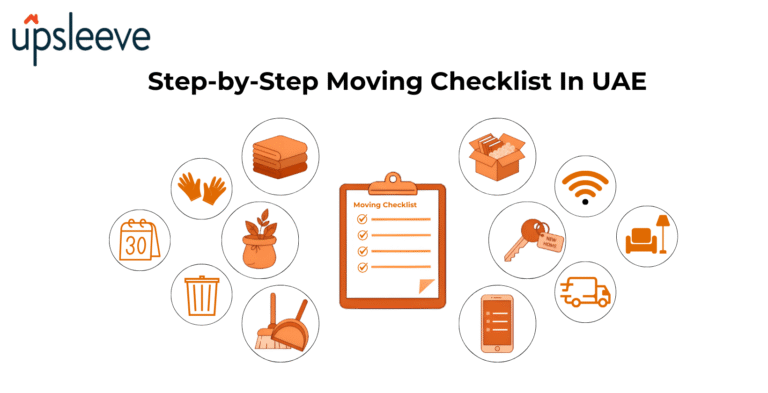
Use a complete moving out checklist to plan, pack, notify utilities, clean, inspect your property, avoid delays, and ensure a smooth, stress-free move.
Learn what relocation means in the UAE, its main types, costs, and a clear step-by-step guide to relocate smoothly with legal, housing, and moving tips.

Discover 12 benefits of hiring professional movers and packers in the UAE, including safe packing, faster moves, cost savings, insurance, and stress-free relocation.
Ready to Move?
Get Your Free Quote
Today
We make moving simple, safe, and stress-free. Our professional team handles everything from packing to delivery with care and precision.
- Professional packing & unpacking services
- Fully insured and licensed movers
- Same-day & next-day availability
- Free, no-obligation estimates
Request a Quote
Fill out the form below and we’ll get back to you as early as possible.