
Data Center Migration: Definition, Types, Phases, and Best Practices
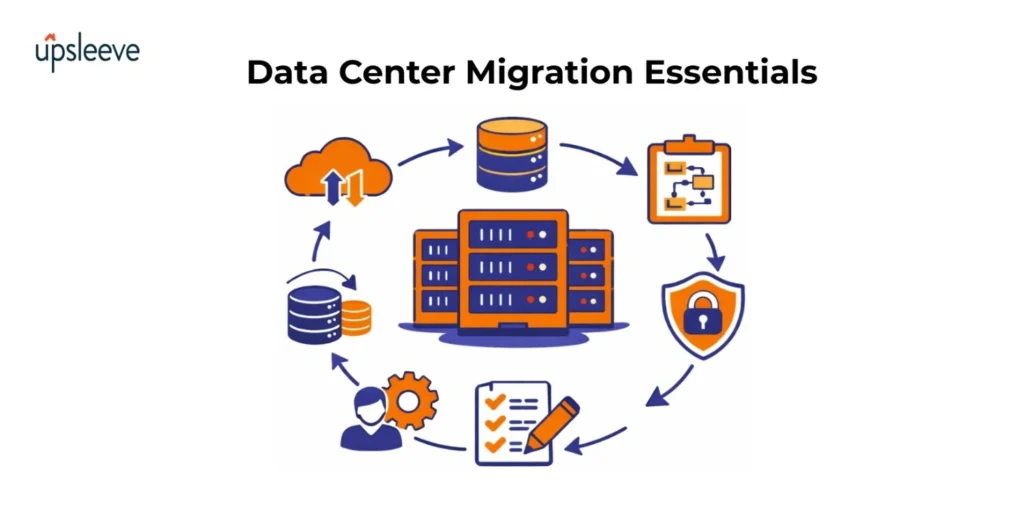
Table of Contents
- What Is Data Center Migration?
- What Are the Types of Data Center Migration?
- Free Zone and Mainland Considerations in UAE Data Center Migration
- What Are the Phases of Data Center Migration?
- What Are the Best Practices for Data Center Migration?
- When Is the Right Time for a Data Center Migration?
- Ready to Move? Get Your Free Quote Today
Data center migration is the process of shifting IT workloads, applications, and infrastructure to a new environment for better performance, enhanced scalability, and smoother operations, while keeping business functions running without interruption. The main types of data center migration are lift and shift, refactoring, replatforming, and hybrid data center migration, with each type involving different migration phases.
A successful data center migration involves different phases such as discovery, analysis, planning, execution, and the post-migration phase. These phases are complemented by efficient data center migration practices that companies follow. The best data center migration practices include asset inventory and assessment, a clear migration plan, stakeholder alignment, starting small and prioritizing workloads, team training and preparation, backup & recovery planning, and testing migration first. Other practices of reliable data center migration include maintaining security and compliance, using flexible infrastructure strategies, and conducting post-migration testing and monitoring.
The right time for a data center migration often arises when existing infrastructure can no longer support business growth, faces high maintenance costs, or requires stronger security. Delaying relocation in such conditions increases the risk of downtime, data loss, or hidden infrastructure conflicts.
What Is Data Center Migration?
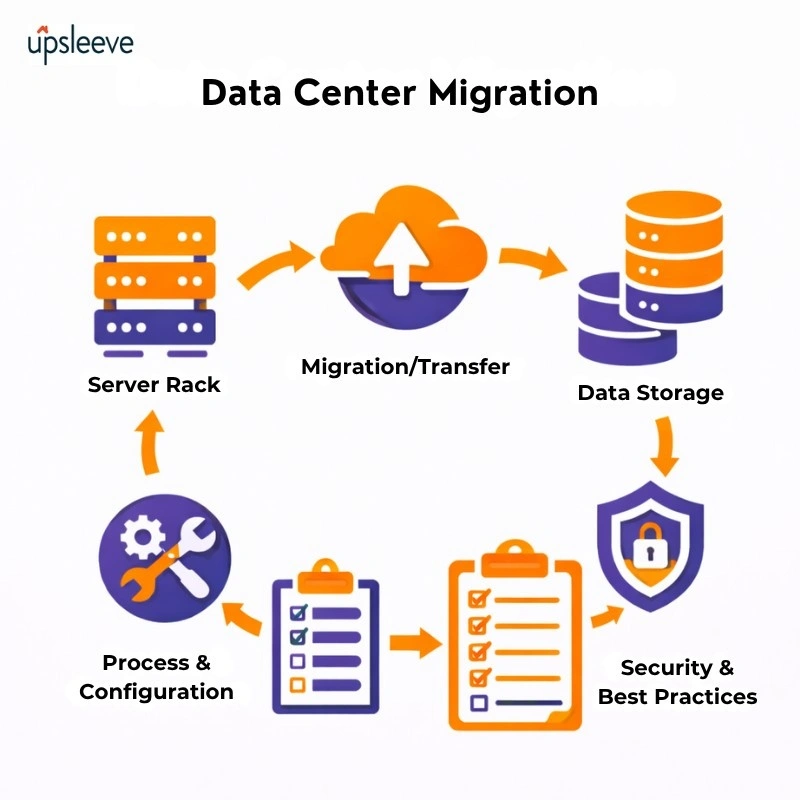
Data center migration is an information technology (IT) infrastructure relocation process that involves moving servers, applications, networks, and enterprise data from one environment to another to improve performance, scalability, and operational efficiency, while minimizing downtime and maintaining business continuity. This process covers physical facilities, cloud platforms, and hybrid environments while maintaining system availability and data integrity during the move.
Data center migration in the UAE moves IT infrastructure across 3 environment types: on-premises server rooms, free zone colocation facilities, and regional cloud platforms. Colocation migration in the UAE targets facilities such as Equinix DX1, DX2, and DX3 in Dubai, Khazna Data Centres in Dubai and Abu Dhabi, Moro Hub in Dubai, and Etisalat’s Smart Hub and datamena. The UAE Internet Exchange (UAE-IX) sits inside the Equinix Dubai campus and manages regional interconnection traffic, making it a critical integration point for organizations migrating between colocation environments. Cloud migration in the UAE targets hyperscale platforms including AWS Middle East (UAE), Microsoft Azure UAE North and UAE Central, and Oracle Cloud UAE East (me-dubai-1) and UAE Central (me-abudhabi-1).
Data center migration directly relocates business-critical workloads, application stacks, and stored data to support operational continuity and regulatory alignment. It supports business continuity by reducing downtime, enables scalability through modern infrastructure, and improves operational efficiency by optimizing performance, controlling costs, and maximizing resource utilization across the IT environment.
Data center movers confirm before the migration that the destination facility meets projected capacity, security, and performance requirements by conducting detailed site assessments, verifying compliance standards, and testing critical systems under simulated loads. They also validate the move through test migrations, structured planning, and verification phases, while coordinating staff schedules and operational workflows to reduce disruption and maintain ongoing business operations.
What Are the Types of Data Center Migration?
The types of data center migration are lift and shift, replatforming, refactoring, and hybrid data center migration. Each migration approach differs in procedural complexity, process cost, and impact on applications, so selecting the right method depends on the organization’s business goals, current infrastructure, and plans for future scalability.
Lift and Shift (Transferring As-Is): Lift and shift migration is a type of data center relocation that involves transferring servers, applications, and storage systems as-is from one environment to another without redesigning workloads. This data center migration is done by using tools like VMware vMotion for live VM replication, Zerto for disaster recovery and continuous data replication, and Azure Migrate or AWS Server Migration Service to transfer workloads while reconfiguring network settings to match the original environment and minimize downtime.
Replatforming (Platform Adjustments): Replatforming migration is a data center relocation process that moves applications and workloads to a modified or upgraded platform to improve performance, compatibility, and scalability with minimal code changes. This migration is executed using tools like Docker for container adjustments, Kubernetes for orchestrating workloads, and AWS Elastic Beanstalk or Azure App Service to adjust platform configurations and provide smooth deployment.
Refactoring (Code & Architecture Revamp): Refactoring migration is used to restructure application code and IT architecture to optimize performance, scalability, and maintainability of applications and workloads during relocation. This migration is performed using tools like Ansible for automated configuration, Jenkins for continuous integration and deployment, and Terraform to rebuild and manage infrastructure while re-architecting workloads to fully utilize modern platforms with minimal downtime.
Hybrid (Mixed Approach): Hybrid migration is a data center relocation approach that combines multiple migration strategies, such as lift-and-shift, replatforming, and refactoring, to move workloads across on-premises and cloud environments efficiently. This migration is executed using tools like VMware vMotion for live VM transfer, AWS Migration Hub for orchestrating cloud workloads, and Kubernetes for container management. Data center migration staff also coordinates network configurations and storage replication to maintain seamless integration between mixed infrastructures.
Free Zone and Mainland Considerations in UAE Data Center Migration
Data center migration in the UAE requires different administrative procedures depending on whether the move crosses free zone or mainland boundaries. Free zone relocations follow asset-movement and licensing rules that differ from mainland procedures, and the migration plan addresses these requirements before the cutover date.
Data center migration in the UAE most frequently originates from or terminates in free zones that host IT infrastructure. The 9 most common free zone locations involved in UAE data center migrations are Dubai Internet City (DIC), Dubai Silicon Oasis under the Dubai Integrated Economic Zones Authority, Dubai International Financial Centre (DIFC), DMCC, Jebel Ali Free Zone (JAFZA), Dubai Airport Free Zone (DAFZA), Dubai Production City, Masdar City in Abu Dhabi, and Abu Dhabi Global Market (ADGM).
IT assets moving out of any of these free zones to a mainland destination require a Dubai Customs gate pass for each rack, server, or networking appliance, matched against the commercial invoice. IT assets crossing from one free zone into a different free zone follow the same gate pass requirement. Facility managers at DIC, Dubai Silicon Oasis, and DMCC issue separate rack-removal and server-room decommissioning approvals before physical de-racking begins. Data center migrations crossing emirate boundaries between Dubai, Abu Dhabi, and Sharjah require customs checkpoint clearances as an additional step in the same administrative process.
What Are the Phases of Data Center Migration?
The phases of data center migration are discovery, analysis, planning, execution, and post-migration. Successful data center migration requires executing each phase methodically, with proper planning and coordination to prevent downtime and ensure seamless transition of IT infrastructure and applications.
These phases of data center migration are described below.
- Discovery: The discovery phase involves assessing the current data center environment, including server inventory, applications, and network dependencies, to identify all workloads and potential migration challenges.
- Analysis: The analysis phase includes evaluating system performance, interdependencies, and risks to determine the most suitable migration strategy and required resources for minimal downtime.
- Planning: The planning phase consists of developing a detailed migration roadmap, covering timelines, tools, staff coordination, and fallback procedures to maintain a smooth transition.
- Execution: Data center migration execution involves moving workloads using tools such as VMware vMotion, Zerto, and Azure and AWS migration services, while monitoring network configurations and system performance in real time. Physical asset transport in Dubai runs in parallel with the technical cutover and requires Roads and Transport Authority (RTA) approval, as the RTA regulates goods vehicle movement across the emirate. Migration teams schedule server and rack transport routes around RTA heavy vehicle restrictions that apply to Business Bay, DIFC, Downtown Dubai, and Dubai Production City. Peak-hour truck bans on main arteries require migration convoys to operate during approved time windows to avoid route violations and delivery delays. Landlord approvals, free zone loading bay bookings, and building NOCs for after-hours access are secured before the truck manifest is confirmed and physical execution begins.
- Post-Migration: The post-migration phase includes validating system performance, resolving issues, optimizing configurations, and stabilizing business operations in the new environment.
What Are the Best Practices for Data Center Migration?
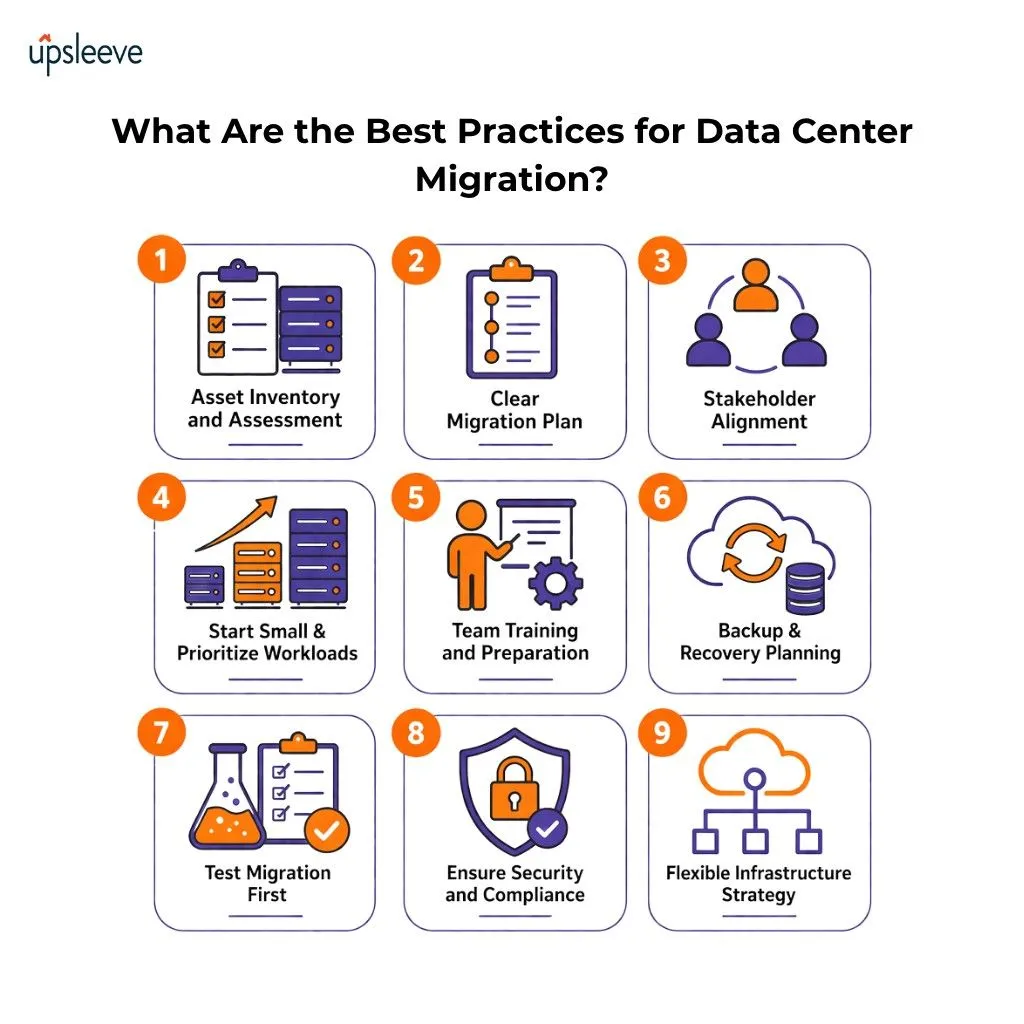
The best practices for data center migration are asset inventory and assessment, a clear migration plan, stakeholder alignment, starting small and prioritizing workloads, team training and preparation, backup & recovery planning, and testing migration first. Data center migration teams also maintain security and compliance, leverage flexible infrastructure strategies, and conduct post-migration testing and monitoring as essential practices for a successful data center migration.
1. Asset Inventory and Assessment
Asset inventory and assessment is a critical practice in data center migration that confirms every server, application, and storage component is accounted for before relocation. The data center migration team conducts a detailed inventory of hardware, software, and application dependencies to identify potential risks and confirm compatibility with the target environment. This thorough assessment allows the team to plan migration sequences accurately, reduce downtime, and maintain seamless business operations during the transition.
This step extends beyond hardware and software to include external utility and authority dependencies at the physical site. Power disconnection and re-energising at Dubai sites are coordinated with the Dubai Electricity and Water Authority (DEWA), Sharjah sites with the Sharjah Electricity, Water and Gas Authority (SEWA), and Abu Dhabi sites with the Abu Dhabi Distribution Company (ADDC). Northern Emirates sites coordinate power disconnection and re-energising with the Federal Electricity and Water Authority (FEWA). Server rooms protected by gaseous fire suppression systems such as FM200 or Novec 1230 require Civil Defence approval before decommissioning, and this approval is captured as a dependency during the assessment phase. The landlord or facility management provider issues a No Objection Certificate (NOC) covering after-hours access and loading bay use, and the inventory confirms this NOC requirement before the migration schedule is finalised.
2. Clear Migration Plan
A clear migration plan is fundamental in data center migration as it defines the timeline, phases, and responsibilities for a structured relocation process. The data center migration team develops a detailed plan to coordinate tasks, manage dependencies, and schedule workloads to minimize downtime and keep business operations uninterrupted throughout the transition.
3. Stakeholder Alignment
Stakeholder alignment in data center migration ensures all relevant parties, including IT teams, management, and end-users, are engaged throughout the process. The data center migration team coordinates with stakeholders to clarify responsibilities, communicate requirements, and prevent miscommunication to reduce the risk of unplanned issues.
| City | Average Piano Moving Cost |
|---|---|
| Dubai | AED 800 to AED 1,800+ |
| Sharjah | AED 550 to AED 2,400+ |
| Ras Al Khaimah | AED 200 to AED 500+ |
| Abu Dhabi | AED 500 to AED 1,500+ |
Planning a Move? Let the Experts Handle It
From home moves to office relocations, our professional movers ensure safe packing, timely transport, and stress-free moving. Get expert help today.
Get a Free Moving Quote4. Start Small and Prioritize Workloads
Starting small and prioritizing workloads is an important practice during data center migration that focuses on migrating less critical systems first to reduce exposure to operational risks. The data center migration team sequences workloads based on dependency mapping and business impact to test smaller systems and identify issues early, which ensures smoother migration for critical applications.
5. Team Training and Preparation
Team training and preparation are useful in data center migration as these steps prepare staff on the new infrastructure and processes before migration. A data center migration team conducts hands-on training and simulation exercises, which enable employees to handle systems efficiently, reduce human errors, and maintain operational continuity during the transition. Team preparation for UAE data center migration includes verifying crew compliance with labour and security requirements that control physical access to data halls. Every migration crew member must hold a valid work permit issued under the Ministry of Human Resources and Emiratisation (MOHRE), and Emirates ID verification is conducted at colocation and free zone security gates before entry. Colocation operators such as Equinix and Khazna issue site access passes to the migration team in advance of the cutover date. Free zone authorities including Dubai Internet City and Dubai Silicon Oasis issue the same passes for tenants hosting IT infrastructure within their zones. Data rooms requiring escorted entry are staffed by security personnel from a company licensed by the Security Industry Regulatory Agency (SIRA) in Dubai.
6. Backup & Recovery Planning
Backup and recovery planning is a critical practice during data center migration to securely back up data and applications before migration. The data center migration team uses disaster recovery tools like Veeam Backup & Replication and Zerto wich help restore lost or corrupted data quickly.
Backup and recovery planning in UAE data center migration includes insuring physical hardware against loss or damage during transport. Rack equipment moving between source and destination sites travels through UAE public roads and requires goods-in-transit insurance placed with a Central Bank of the UAE licensed insurer. Declared values in the policy align to the VAT-inclusive replacement cost of each insured item. The policy assigns liability between the mover and the client across 3 physical stages that include de-racking, road transport, and re-racking. Landlords and free zone authorities require the certificate of insurance before granting site access to the migration team.
7. Test Migration First
Testing migration first involves conducting a trial migration of selected systems to identify potential issues before the full data center move. Upsleeve’s migration team executes pilot migrations using sandbox environments and controlled replication tools such as VMware vMotion for live VM testing, Zerto for continuous replication, and Azure/AWS Migration Services to detect configuration errors, network bottlenecks, and compatibility issues.
8. Ensure Security and Compliance
Adhering to compliance frameworks and security protocols reduces operational and legal risks by preventing data breaches, misconfigurations, and unauthorized access. Moving companies like Upsleeve implement encrypted transport, access controls, and compliance audits during relocation to keep large IT centers safe and fully compliant at every stage of the move.
Security and compliance in UAE data center migration are governed by federal and emirate-level regulations that determine where data resides during and after the move. Federal Decree-Law No. 45 of 2021 on the Protection of Personal Data (UAE PDPL) governs the processing and transfer of personal data and carries data residency implications for workloads that cross UAE borders.
The Telecommunications and Digital Government Regulatory Authority (TDRA) issues the UAE Information Assurance Regulation, setting management and technical security controls for designated entities during and after migration. These controls align with the Information Assurance Standards originally issued by the National Electronic Security Authority (NESA), now operating as the UAE Signals Intelligence Agency (SIA). Dubai-based government and private entities undergoing data center migration additionally comply with security rules set by the Dubai Electronic Security Center (DESC).
9. Align with UAE Sector Regulators Before Migrating Regulated Workloads
Regulated industries in the UAE follow a sector-specific compliance layer that the migration team validates alongside the federal framework before migrating any regulated workload. Banks, insurers, exchange houses, and payment service providers align with the Central Bank of the UAE (CBUAE) Cybersecurity Framework, which sets requirements for data handling, access control, and incident response across any infrastructure change including data center migration. Healthcare organizations migrating workloads comply with the Dubai Health Authority (DHA) in Dubai, the Department of Health Abu Dhabi (DoH) in Abu Dhabi, and the Ministry of Health and Prevention (MOHAP) at the federal level, each enforcing rules on patient data storage and transfer during migration. DIFC tenants migrating workloads within or out of the Dubai International Financial Centre comply with DIFC Data Protection Law No. 5 of 2020. ADGM tenants follow the ADGM Data Protection Regulations 2021 for any workload migration affecting Abu Dhabi Global Market infrastructure. The migration team identifies the relevant regulator for each workload type and confirms pre-move notification duties before the cutover date.
10. Use Flexible Infrastructure Strategy
A flexible infrastructure strategy enables data center migration teams to implement scalable and adaptable systems that accommodate future growth and evolving business needs. This type of flexible infrastructure supports cloud integration and hybrid setups by allowing workloads to shift between on-premises and cloud environments, maintaining operational efficiency and minimal disruption.
Hybrid data center migrations crossing the UAE border bring Dubai Customs and the UAE Federal Tax Authority (FTA) into the migration workflow as 2 additional regulatory authorities. Dubai Customs processes import, export, and re-export declarations for server hardware, networking equipment, and storage arrays moving in or out of the UAE, and supports temporary import procedures for loaner or swap units used during the cutover phase. The FTA applies the standard 5% VAT rate to taxable supplies of data center migration services, and properly structured invoice documentation supports the client’s input VAT recovery after the migration is complete.
11. Post-Migration Testing and Monitoring
Post-migration testing and monitoring confirm that all applications and systems perform as expected after the data center move. This continuous monitoring helps detect performance bottlenecks and configuration issues early, so the migration team can resolve them quickly and maintain operational efficiency.
When Is the Right Time for a Data Center Migration?
The right time for a data center migration is when transformation or consolidation demands arise because existing infrastructure no longer supports business growth or workload expansion. This situation often appears when systems carry high maintenance costs, show performance delays, or require stronger security controls during IT relocation planning.
Choosing the right migration window in these scenarios helps organizations reduce long-term costs, strengthen security, and improve operational efficiency. Proper timing of the data center migration also enables IT teams to optimize systems, rebalance workloads, and maximize resource utilization while relocating infrastructure to a new site.
What Are the Best Tools for Data Center Migration?
The best tools for data center migration are given below.
- On-Premise Migration Tools: These tools manage physical and logical relocation by documenting server dependencies, rack layouts, and network links. Examples of on-premise migration tools include SolarWinds Server and Application Monitor and BMC Discovery used for asset mapping and dependency tracking.
- Open-Source Migration Tools: These tools support controlled data transfer and configuration alignment through scripts and automation, with common examples such as rsync for file replication and Ansible for configuration management across source and target environments.
- Cloud-Based Migration Tools: These tools automate workload movement and validation for cloud or hybrid transitions, with examples like AWS Server Migration Service and Azure Migrate used to transfer virtual machines and application workloads with minimal disruption.
What Are the Challenges in Data Center Migration?
The challenges in Data Center Migration are described below.
- Unrealistic Time Expectations: Data center migration timelines often fail when unrealistic time expectations are set, ignoring application dependencies, data volume, and approval cycles, which causes rushed execution and avoidable service gaps.
- Hidden Infrastructure Complexities: Data center relocation team often overlooks hidden infrastructure complexities, such as legacy systems, undocumented network links, and mixed hardware environments that can create technical conflicts during execution and delay the relocation process. UAE-specific climate and calendar conditions create hidden infrastructure complexities that directly affect the data center relocation cutover window. Summer temperatures between May and September require climate-controlled moving trucks for transporting servers, tape media, and battery-backed storage between sites. Destination sites connected to district cooling providers such as Empower, Emicool, or Tabreed require chilled water supply commissioning as a hidden prerequisite before racks are re-energised. Ramadan working hours reduce daytime crew availability and narrow the daily physical relocation window, adding scheduling complexity to the migration plan. The UAE Saturday-Sunday weekend is the standard cutover window for business-critical workloads, and the migration schedule confirms this window before the cutover date is set.
- Disrupted Work Schedules: Data center migration activities can interrupt staff workflows when cutover windows, access restrictions, or extended testing overlap with normal business operations.
Insufficient Data Backup: Missing or incomplete backups increase the risk of permanent data loss if transfer errors, system failures, or rollback scenarios occur during migration.

Learn how much movers cost in the UAE, including pricing factors, apartment size, distance, services included, and tips to plan your moving budget.
Use a complete moving out checklist to plan, pack, notify utilities, clean, inspect your property, avoid delays, and ensure a smooth, stress-free move.
Learn what relocation means in the UAE, its main types, costs, and a clear step-by-step guide to relocate smoothly with legal, housing, and moving tips.

Discover 12 benefits of hiring professional movers and packers in the UAE, including safe packing, faster moves, cost savings, insurance, and stress-free relocation.
Ready to Move?
Get Your Free Quote
Today
We make moving simple, safe, and stress-free. Our professional team handles everything from packing to delivery with care and precision.
- Professional packing & unpacking services
- Fully insured and licensed movers
- Same-day & next-day availability
- Free, no-obligation estimates
Request a Quote
Fill out the form below and we’ll get back to you as early as possible.