
What Is Container Storage? Types, Uses and Benefits
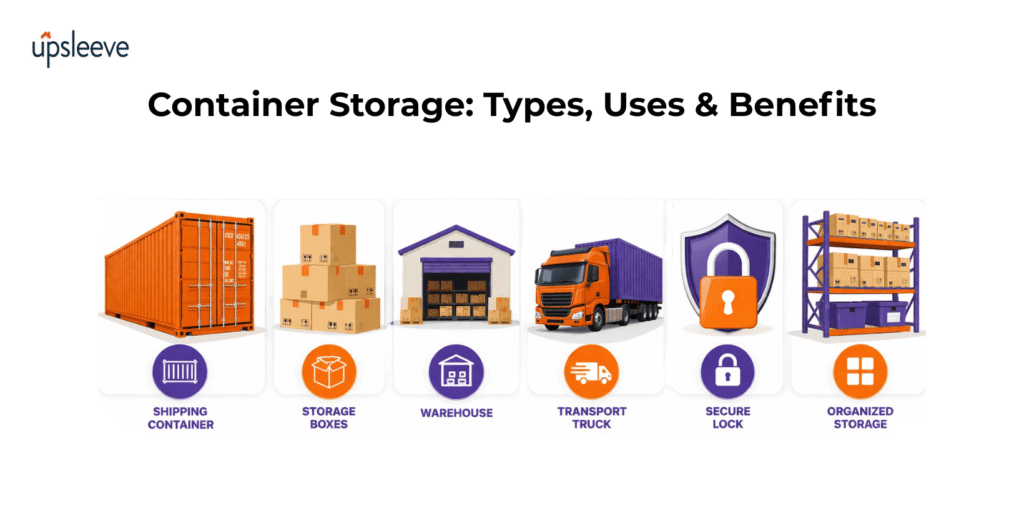
Container storage refers to a flexible storage solution that uses portable or fixed containers to securely hold and protect goods for short‑term and long‑term storage. These storage units have different features, capacities, and use cases depending on the storage requirements and type of container used. The main types of container storage include standard shipping containers, high-cube containers, refrigerated containers, portable storage containers, flat-rack containers, and open-top units.
Container storage units are widely used by businesses, homeowners, and movers for secure and accessible storage during relocations, renovations, inventory management, or space optimization. Container storage offers features such as flexible sizing and container types, weatherproof construction, strong security systems, and easy on-site accessibility. It protects inventory, household items, and equipment from damage, theft, and environmental exposure, making storage more efficient and reliable under temporary space constraints.
In the UAE, extreme heat, humidity, and limited space during relocations or renovations often make it difficult to store goods safely without risk of damage or clutter. So, hiring a container storage service provides you with a reliable and weather-resistant solution for safeguarding everything from bulky equipment to sensitive goods.
What Is Container Storage?
Container storage is a secure and portable storage solution made from durable materials such as corten steel or aluminum to hold, store, protect and transport goods, materials, or equipment for temporary or long-term storage. These containers come in standardized dimensions such as 20-foot (6.1 m) and 40-foot (12.2 m) lengths, with widths of 8 feet (2.44 m) and heights of 8.5 feet (2.59 m) with substantial internal volume. Container storage units provide flexibility in their size and type to accommodate different storage needs. These storage units feature reinforced walls, lockable doors, and tamper-resistant designs for safety and security for valuable items.
Container storage is weatherproof and highly durable, constructed from corten steel with a tensile strength of 52,000 to 70,000 psi. It is capable of supporting superimposed stacking loads of up to 192,000 kg (approximately 212 tons) when stacked, and is built to withstand extreme weather conditions such as heavy rain, heat, and strong winds over a service life of 15 to 25 years. Container storage offers easy accessibility with doors wide enough for forklifts (7 feet 8 inches / 2.34 m), complies with ISO 668 and CSC safety standards allowing stacking up to 9 containers high. This storage unit can be modified with insulation (U-values 0.3 to 0.5 W/m²K), ventilation (4 to 6 air changes per hour), or refrigeration units capable of maintaining −25°C to +25°C.
What Are the Types of Container Storage?
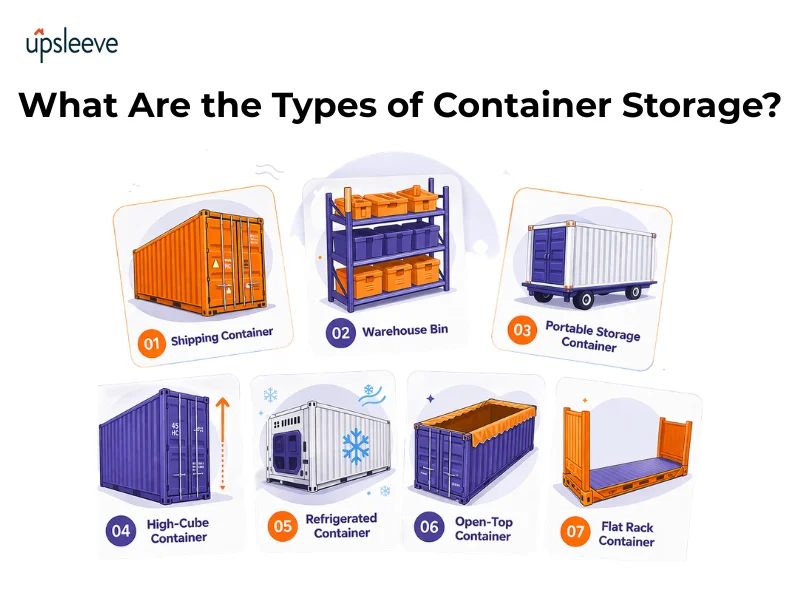
The types of container storage include shipping containers, warehouse bins, portable storage containers, high-cube containers, refrigerated containers, open-top containers, and flat rack containers. These types of container storage are tailored to different storage requirements, providing solutions that vary in size, accessibility, and protective features to safely accommodate a wide range of goods and materials.
The main types of container storage are explained below.
Shipping Container
A shipping container is a standardized steel storage unit designed for the secure transportation and storage of goods across international and domestic supply chains via ships, trucks, and trains without unpacking.
Shipping containers are constructed from corrosion-resistant corten steel which makes them highly durable, weatherproof, and capable of withstanding heavy rain, strong winds, saltwater exposure, and extreme temperatures. They are equipped with corrugated corten steel walls reinforced with internal cross-members and sturdy corner posts, lockable double doors, and a sealed structure to protect against theft and moisture. Standard sizes of shipping containers include 20-foot (approximately 6 meters) and 40-foot (approximately 12 meters) containers, with variations such as high-cube containers offering additional height for increased storage capacity.
Shipping containers are used to store and transport a wide range of items, including packaged goods, industrial equipment, machinery, raw materials, retail inventory, and non-perishable products. They also accommodate temperature-sensitive goods like pharmaceuticals, fresh produce, frozen foods, and specialized cargo such as chemicals or electronics, depending on modifications.
Warehouse Bin
A warehouse bin is a storage container used within warehouse systems to organize, store, and manage small to medium-sized items like screws, bolts, electronic components, or packaged consumer goods in a structured and easily accessible manner. This storage bin is commonly integrated into shelving or racking systems to support efficient inventory handling and retrieval of stored goods. Warehouse bins are made from durable plastic or metal, such as steel and stainless steel which offer resistance to wear, impact, and moisture. They are designed with open fronts or stackable structures like bins, crates, and shelving units for quick access and space optimization, and feature dedicated label slots or panels on each compartment for clear inventory identification.
Warehouse bins come in small, medium, or large sizes that are usually measured in inches or centimeters. Warehouse bins are used to store items such as spare parts, tools, hardware components, retail products, office supplies, and packaged goods. They are especially useful for organizing high-volume, small-sized inventory because their modular design and systematic layout allow for efficient categorization and quick picking of items.
Portable Storage Container
A portable storage container is a relocatable, ground-level storage unit delivered directly to a specific location such as a home, retail site, or construction area for temporary storage during a move, renovation, or short-term operational storage needs.
Portable storage containers are specifically designed with integrated lifting points, forklift pockets, and trailer-compatible bases, allowing them to be easily picked up, loaded, and relocated without unloading the contents. They feature lightweight yet durable steel or composite panels, roll-up or side-access doors for quick loading in tight spaces.
Portable storage containers are commonly available in compact sizes such as 8-foot, 10-foot, 12-foot, 16-foot, and 20-foot units to support residential moves, on-site storage, and short-distance transport. These storage containers are used to store household items such as furniture, appliances, and personal belongings during moves or renovations as well as business inventory, tools, equipment, and seasonal stock that require temporary and accessible storage solutions.
High-Cube Container
A high-cube container is a specialized type of shipping container that offers additional vertical space compared to standard containers, suitable for storing and transporting taller or bulkier cargo. High-cube containers are typically 9.5 feet (approximately 2.9 meters) tall which makes them about 1 foot taller than standard containers and they have lengths of 20 feet and 40 feet. This extra height allows for better stacking of goods, improved air circulation, and accommodation of oversized items that cannot fit in standard-height containers. They are constructed from durable corten steel to provide weather resistance, structural strength, and secure sealed storage.
High-cube containers are used to store and transport items such as large machinery, industrial equipment, furniture, stacked retail inventory, lightweight bulky goods (e.g., textiles or foam products), and palletized cargo that requires additional vertical clearance.
Refrigerated Container
A refrigerated container (also known as a reefer container) is a temperature-controlled storage unit designed to transport and store perishable or temperature-sensitive goods like medicines under regulated temperature and relative humidity. Refrigerated containers have built-in refrigeration units capable of maintaining temperatures ranging from -30°C to +30°C (-22°F to 86°F), depending on cargo requirements. Refrigerated containers are used to store and transport items such as fresh produce, meat, seafood, dairy products, pharmaceuticals, vaccines, and other temperature-sensitive goods that require controlled environments to maintain quality and safety.
They are insulated with high-performance materials such as polyurethane foam and expanded polystyrene to minimize external heat transfer, and include air circulation systems to ensure uniform cooling across all stored items. Standard sizes of refrigerated containers include 20-foot and 40-foot reefers with high-cube variants available for additional capacity.
Planning a Move? Let the Experts Handle It
From home moves to office relocations, our professional movers ensure safe packing, timely transport, and stress-free moving. Get expert help today.
Get a Free Moving QuoteOpen-Top Container
An open-top container is a cargo container specifically designed for top-loading of oversized or vertically large goods that cannot be loaded through standard container doors. Open-top containers have a removable steel roof frame and a heavy-duty tarpaulin cover instead of a fixed roof which allows direct crane access from above. They also include sturdy side rails and floors to support heavy and uneven loads as well as lashing rings to secure cargo during transit.
The open-top container has standard sizes such as 20-foot and 40-foot, with the same length and width as standard containers but designed to accommodate cargo that exceeds the container’s height as long as it stays within the allowed limits. Open-top containers are used to transport items such as tall industrial machinery, large generators, construction equipment, steel structures, marble slabs, timber logs, and heavy cargo that requires vertical loading or exceeds the height capacity of standard containers.
Flat Rack Container
A flat rack container is a heavy-duty and open-structure storage container that is designed for transporting out-of-gauge cargo, items that exceed standard container width or height limits. This storage container has no side walls and only end walls (fixed or collapsible) unlike standard containers which allow cargo to extend beyond the container frame. Flat rack containers are used to transport specific types of cargo such as excavators, tractors, large construction equipment, steel beams, wind turbine components, and oversized machinery that cannot fit inside enclosed containers due to their dimensions or shape.
Flat rack containers are built with a reinforced steel base and lashing points to secure extremely heavy and irregular loads during transit. They are commonly available in 20-foot and 40-foot sizes with high load-bearing capacity for industrial transport.
What Are the Common Uses of Container Storage?
The common uses of container storage include shipping and logistics operations, on-site storage, construction-site storage, emergency and disaster relief, and modular workspace development. These applications highlight the versatility of container storage, allowing it to adapt to both operational and temporary storage needs across different industries.
The common uses of container storage are given below.
- Shipping and Logistics Operations: Container storage is primarily used in global supply chains to move bulk goods, packaged cargo, and raw materials across sea freight, rail systems, and trucking networks within a single sealed unit. Their standardized size allows direct transfer between ships, trucks, and trains using cranes and handling equipment which eliminates the need to unload and repack goods at each stage and reduces transit time and damage risk.
- On-Site Storage Use: Containers are used for on-site storage to store inventory, tools, raw materials, and operational supplies directly at the location where they are needed, such as warehouses, retail backends, or industrial sites. This eliminates delays caused by off-site storage, reduces transportation time and costs, and provides immediate access to essential items during daily operations.
- Construction Site Storage: Container storage functions as secure units on construction sites for storing machinery, tools, and building materials. Their durable steel structure protects assets from theft, weather exposure, and site-related damage to support continuity of operations.
- Emergency and Disaster Relief: Container storage is deployed in disaster-affected areas to store relief supplies such as food, medical equipment, and essential goods. Their portability and quick deployment make them effective for establishing temporary storage infrastructure in critical situations like floods, earthquakes, hurricanes, or other natural and humanitarian emergencies.
- Modular Office Units: Container storage units can be converted into modular office units for remote sites, construction zones, and temporary workplaces. They provide a practical and relocatable workspace environment with added insulation, electrical fittings, and interior modifications like lighting systems, flooring, windows, ventilation, and partitioned sections.
What Are the Benefits of Container Storage?
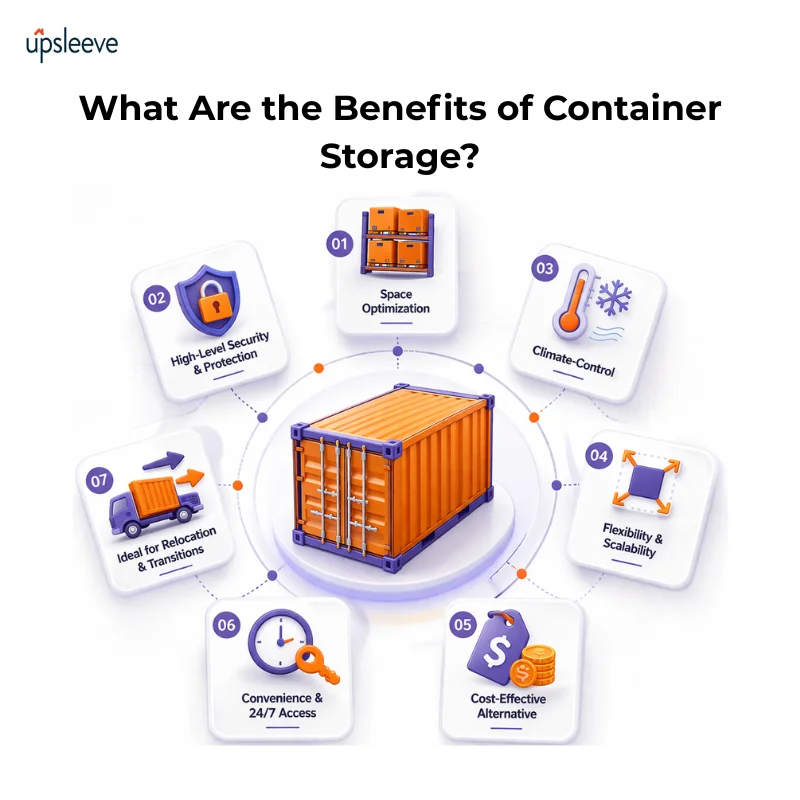
The benefits of container storage include space optimization, high-level security and protection, climate control, convenient 24/7 access, and an ideal solution for transitions and relocations. These benefits make container storage a reliable and flexible solution for both personal and commercial storage needs.
The advantages of container storage are provided below.
- Space Optimization: Container storage maximizes space utilization with a compact, stackable structure that allows vertical and horizontal storage, helping businesses and individuals efficiently organize goods within limited space.
- High-Level Security & Protection: Container storage units provide a high level of protection by restricting physical access through single-entry steel doors fitted with heavy-duty locking mechanisms. Enclosed and tamper-resistant structure of container storage prevents forced entry, weather damage, and unauthorized handling to reduce the risk of unauthorized access and supports the secure storage of valuable assets.
- Climate-Control: Container storage units are equipped with insulation, ventilation, and temperature-regulating systems to regulate internal conditions and prevent heat buildup, condensation, and humidity fluctuations. This helps protect sensitive items such as paper documents from moisture damage, electronics from heat exposure, and temperature-sensitive goods like medicines, vaccines, perishable food, and chemical reagents from spoilage.
- Flexibility & Scalability: Container storage offers flexibility by allowing users to scale storage capacity up or down and add or relocate containers as operational needs change, all without long-term commitments.
- Cost-Effective Alternative to Renting Space: Container storage offers a cost-efficient alternative to renting spaces and traditional storage facilities by eliminating construction costs and reducing ongoing expenses such as rent, utilities, and climate control. Container storage requires minimal maintenance due to its durable steel structure, which results in lower long-term operational spending.
- Convenience & 24/7 Access: They provide convenient and round-the-clock access by allowing you to store containers directly on-site or in easily accessible locations which eliminates dependency on facility operating hours and third-party coordination. This supports uninterrupted workflows and time-sensitive operations by enabling immediate retrieval or storage of items whenever required, supporting uninterrupted workflows and time-sensitive operations.
- Ideal for Relocation & Transitions: Container storage supports relocation and transitional phases of moving or shifting operations by allowing goods to be packed, stored, and transported within the same unit which minimizes handling, reduces damage risk, and simplifies moving processes.
How to Choose the Right Container Storage Unit?
To choose the right container, assess your storage needs, consider customization options, evaluate cost and budget, plan for location and accessibility, research provider reputation and reviews for practical, efficient, and convenient storage. This step-by-step approach helps ensure the selected container aligns with your specific requirements while delivering reliable performance and long-term value.
To choose the right storage container, follow the steps given below.
- Assess Your Storage Needs: Determine the type, volume, and nature of items you plan to store to select the appropriate container size, material, and features.
- Customization Options: Check whether the container can be modified with shelving, insulation, ventilation, or partitioning to meet specific storage or operational requirements.
- Cost and Budget Considerations: Compare the purchase, rental, and maintenance costs of different containers to make sure the chosen unit fits your budget while providing long-term value.
- Location and Accessibility: Consider where the container will be placed and how easily you can access it, with on-site placement, ground-level access, and 24/7 availability for convenience and efficiency.
- Versatility and Relocability: Evaluate whether the container can be repurposed or moved as portable or modular units, which offer flexibility for relocation, expansion, or temporary storage.
- Provider Reputation and Reviews: Research storage container suppliers and read customer reviews to ensure reliability, service quality, and timely delivery because a reputable provider reduces the risk of damage or delays.
- Regulatory Compliance: Check that the container meets local safety, building, and transport regulations to prevent legal issues and ensure the storage unit is safe for both people and goods.
How Much Does Container Storage Cost in the UAE?
Container storage cost in the UAE ranges from AED 2,000 to AED 10,000, depending on the container’s size, condition (new or used), and location of delivery or placement. The average price range for container storage varies by size, with 8 to 10 ft portable units costing AED 2,000 to 3,500, 20 ft standard containers priced at AED 4,000 to 6,000, and 40 ft or high-cube containers ranging from AED 7,000 to 10,000.
What Are the Dimensions of a Container Storage?
The dimensions of container storage range from 20 feet to 40 feet in length, around 8 feet in width, and 8.5 to 9.5 feet in height. A 20-foot container provides about 1,170 cubic feet of storage space while a 40-foot container offers around 2,390 cubic feet. High cube containers have the same length and width but a taller height of about 9.5 feet for extra storage capacity.
What Is the Difference Between a Shipping Container and a Container Storage?
The difference between a shipping container and container storage lies in their purpose, accessibility, customization options and usage. A shipping container is designed for transporting goods across long distances, while a container storage is designed for storing items safely for short-term or long-term needs.
The differences between a shipping container and a container storage are summarized in the table below.
| Feature | Shipping Container | Container Storage |
|---|---|---|
| Primary Purpose | Designed for transporting goods across locations like sea, rail, and road | Used for storing items securely for short-term or long-term needs |
| Mobility and Durability | Highly durable and built for frequent movement in harsh conditions | Durable but mainly used in a fixed position for storage purposes |
| Accessibility and Convenience | Not always easily accessible during transit or stacking | Easily accessible and placed at ground level for convenient use |
| Standardization | Built in standardized sizes (e.g., 20ft, 40ft) for global shipping | May use standard containers but not limited to strict shipping standards |
| Customization | Limited modifications due to transport regulations | Can be customized with shelves, lighting, insulation or climate control features |
What Is the Difference Between Storage Containers and Storage Units?
The difference between storage containers and storage units involves differences in their mobility, access, environmental control, security, purpose, and cost. Storage containers offer portability and on-site access but limited environmental control while storage units provide fixed, facility-based storage with controlled conditions, higher security, and organized access.
This difference between storage containers and storage units is highlighted in the table given below.
| Feature | Storage Containers | Storage Units |
|---|---|---|
| Mobility | Highly portable; can be moved to different locations via trucks or trailers. | Fixed location; cannot be easily relocated once rented. |
| Access | Accessible at customer location or company storage facility (with controlled access). | Provides 24/7 access within a facility; easy entry for daily use. |
| Environment / Climate Control | Usually non-climate-controlled; some containers can be insulated or refrigerated. | Often climate-controlled with regulated temperature and humidity for sensitive items. |
| Security | Secure with steel walls and lockable doors but protection depends on the location. | Facility-managed security with surveillance, alarms, and controlled entry. |
| Best Use / Purpose | Ideal for transport, temporary storage, construction sites, or relocation. | Best for long-term storage of personal belongings, documents, inventory, or sensitive items. |
| Cost | One-time purchase or short-term rental; low cost for temporary or portable use. | Monthly rental fees; cost is higher due to facilities, climate control, and security services. |
Are Self Storage Containers Affordable?
Yes, self-storage containers are generally affordable because they offer flexible pricing based on duration, size, and usage needs. They are more budget-friendly when you choose standard-sized containers without additional customization or climate control features. The cost of self-storage containers ranges from about AED 300 up to AED 3,000+ per month depending on unit size, duration, and features.
Learn how much movers cost in the UAE, including pricing factors, apartment size, distance, services included, and tips to plan your moving budget.
Use a complete moving out checklist to plan, pack, notify utilities, clean, inspect your property, avoid delays, and ensure a smooth, stress-free move.
Learn what relocation means in the UAE, its main types, costs, and a clear step-by-step guide to relocate smoothly with legal, housing, and moving tips.

Discover 12 benefits of hiring professional movers and packers in the UAE, including safe packing, faster moves, cost savings, insurance, and stress-free relocation.
Ready to Move?
Get Your Free Quote
Today
We make moving simple, safe, and stress-free. Our professional team handles everything from packing to delivery with care and precision.
- Professional packing & unpacking services
- Fully insured and licensed movers
- Same-day & next-day availability
- Free, no-obligation estimates
Request a Quote
Fill out the form below and we’ll get back to you as early as possible.