
Learn how much movers cost in the UAE, including pricing factors, apartment size, distance, services included, and tips to plan your moving budget.
Water Transportation: Definition, Methods, Types, Benefits and Challenges
Last Updated: March 27, 2026
Table of Contents
- What Is Water Transportation?
- What Are the Main Methods of Water Transportation?
- What Are the Different Types of Water Transportation?
- What Are the Benefits of Water Transportation?
- What Are the Challenges of Water Transportation?
- How Does Water Transportation Compare to Road, Rail, and Air?
- Ready to Move? Get Your Free Quote Today
Water transportation is the movement of goods and people across seas, oceans, rivers, and canals using ships, boats, and other vessels. The main methods of water transportation include inland waterways for navigating rivers and lakes, ocean transport for long-distance international shipping, and coastal shipping along shorelines to connect regional ports.
Water transportation types include cargo transportation for moving bulk goods, containers, and raw materials across domestic and international routes. Passenger transportation using ferries, cruise ships, and water taxis for commuting, tourism, and leisure travel. Special-purpose vessels are designed for non-standard tasks such as research, rescue operations, surveying, and icebreaking.
Water transportation provides key advantages such as lower operational costs, higher energy efficiency, and the ability to carry large and heavy cargo. Use of water transport rather than that of air or road also reduces environmental impact, ensures safe handling of hazardous materials, supports international trade, alleviates road congestion, and offers reliable long-distance shipping.
Challenges in water transportation include managing environmental impacts such as water pollution and habitat disruption, ensuring compliance with complex international and local maritime regulations, and coordinating seamless transfers across multiple transport modes to maintain efficiency and prevent delays. Advanced planning, regulatory oversight, and technological integration are essential to address water transportation challenges.
What Is Water Transportation?
Water transportation is the movement of goods and people across seas, oceans, rivers, and canals using ships, boats, and other watercraft. Water transport moves cargo and passengers efficiently across short and long distances using vessels such as ships, ferries, and boats. Global trade and logistics rely on water transportation to connect markets and enable the large-scale movement of goods across countries and continents.
Water transportation drives economic growth by supporting industries, reducing shipping costs, and enabling large-scale commerce, while promoting environmental sustainability through lower emissions and energy-efficient operations. Historically, water transport shaped maritime trade routes and port cities, and strict regulatory frameworks guarantee safety, compliance, and efficient management of vessels and cargo.
What Are the Main Methods of Water Transportation?
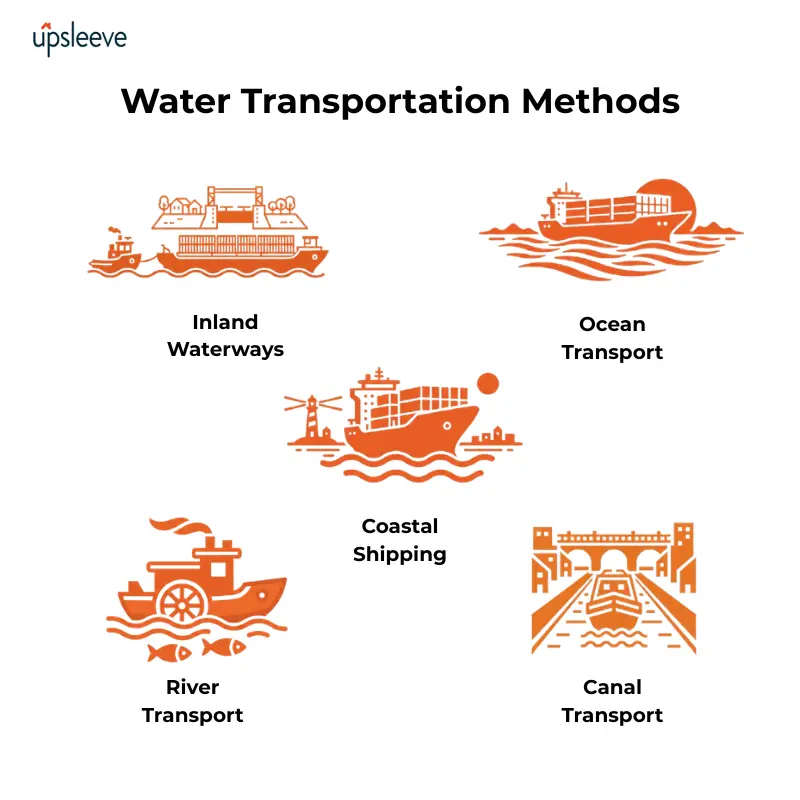
The main methods of water transportation include inland waterways, ocean transport, coastal shipping, river transport, and canal transport, each facilitating efficient movement of goods and passengers across different water routes.
Inland Waterways
Inland waterways are rivers, canals, and lakes used for transporting goods and passengers within a country or region.
Rivers transport cargo and passengers by providing continuous natural channels that boats and barges navigate between inland ports. Lakes allow vessels to move goods and people across larger inland areas where river connections may be limited. Canals link rivers and lakes by creating controlled and direct routes that move cargo and passengers faster and more efficiently over short to medium distances.
Barges are flat-bottomed vessels used on rivers and canals to carry heavy bulk cargo like coal, grain, or construction materials. Lighters are smaller vessels that transport goods between larger ships and inland ports where direct docking is not possible. Riverboats are designed to navigate rivers and canals by carrying both cargo and passengers over short to medium distances. Passenger ferries operate on rivers and lakes by transporting people across inland waterways on scheduled routes.
Historically, inland waterways have enabled communities to connect, trade goods, and transport people before the development of roads and railways. Inland waterways movement of raw materials and agricultural products within regions, supporting local economies. Economically, inland waterways continue to provide cost-effective transport for bulk goods and reduce pressure on road and rail networks.
Ocean Transport
Ocean transport is the movement of goods and passengers across seas and oceans using large ships that connect international ports through established maritime routes.
Large ships move cargo and passengers across oceans through powerful propulsion systems that push the vessel forward and maintain steady movement in deep waters. Advanced navigation technology, radar, and satellite systems guide ships along established maritime routes for accurate and safe ocean travel.
Container ships carry standardized containers stacked on deck and in holds for the organized transport of diverse goods. Bulk carriers are designed to transport unpackaged bulk materials including grains, coal, or ores in large cargo holds. Oil tankers and LNG carriers are specialized vessels with reinforced tanks designed to transport liquid cargoes including crude oil, petroleum products, and liquefied natural gas. Cruise ships transport passengers for leisure travel, while RO-RO (Roll-On/Roll-Off) ships carry vehicles and wheeled cargo that are driven on and off the vessel.
Historically, ocean transport allowed countries to explore new lands, trade goods across continents, and establish global trade routes. International ports have utilized ocean shipping to grow commerce and expand access to foreign markets. Maritime trade supported major economies by enabling the mass movement of raw materials and finished goods. Global supply chains now rely heavily on ocean transport to maintain stable import and export activities for the world’s economies.
Coastal Shipping
Coastal shipping is the transport of goods and passengers along a country’s coastline using ships that travel between domestic ports.
Ships operate along coastlines by following established sea routes that link domestic ports within a country or region. Cargo is loaded at one port and transported to another, while passengers board and disembark at designated ports. Coastal navigation uses lighthouses, buoys, and modern instruments to maintain safety and offers efficient movement between ports.
Coastal cargo ships transport goods including containers, bulk materials, and manufactured products between domestic ports along the coastline. Coastal tankers transport liquid cargo like petroleum, chemicals, and other fluids safely across short sea routes. RO-RO ships transport vehicles, while passenger ferries carry people between coastal ports on scheduled routes.
Coastal shipping, historically, connected port towns and facilitated trade between regions before the development of extensive road and rail networks. Coastal cargo facilitates the movement of local goods, raw materials, and agricultural products along the coastline and supports regional economies. Over time, coastal shipping became a valid link for domestic trade, which reduced transport costs and connected smaller ports to major commercial centres.
River Transport
River transport is a mode of transportation that utilizes rivers as natural routes for travel and cargo movement using boats, barges, and other vessels.
Navigable rivers allow boats and barges to travel between inland towns, cities, and ports, carrying cargo and passengers. Cargo is loaded at one river port and transported downstream or upstream to another by following the natural flow of the river. Passengers use riverboats and ferries to travel along the river waterways, which provide an efficient means of inland transportation.
Barges are flat-bottomed vessels used on rivers to carry heavy bulk cargo such as coal, grains, and construction materials. River ferries transport passengers and vehicles across rivers on scheduled routes. Cargo vessels navigate rivers to move goods between inland ports, supporting trade within regions. Paddle steamers are traditional vessels powered by paddle wheels, which were used for both passenger travel and cargo transport along rivers.
River transport historically connected inland communities, enabling the movement of goods and people before roads and railways were developed. Cargoes in the river carried agricultural products, raw materials, and manufactured goods, which support the growth of regional economies.
Canal Transport
Canal transport involves the conveyance of goods and people using boats or barges along artificial waterways known as canals.
Man-made canals link rivers, lakes, and ports by providing direct routes for transporting cargo and passengers. Controlled water levels and navigable channels allow vessels to move safely and efficiently between different regions. Canal boats and ferries carry people and goods along canal waterways, which support inland transport and regional connectivity.
Narrowboats are long and slim vessels designed to navigate the tight locks and narrow channels of canals. Cargo vessels transport goods including raw materials, food products, and manufactured items, along canal routes. Passenger boats transport people for commuting or leisure travel on canals by connecting towns and cities. Some vessels are specifically designed to handle both cargo and passengers by making canal transport versatile for regional trade and travel.
Canal transport represents major engineering progress by creating controlled waterways with locks, levees, and channels that connect regions not naturally linked by rivers. Historically, canals supported early industrial development by enabling the steady movement of coal, timber, grain, and manufactured goods. In domestic trade, canal networks provided reliable routes for cargo and passengers, strengthening regional supply chains and market access.
Planning a Move? Let the Experts Handle It
From home moves to office relocations, our professional movers ensure safe packing, timely transport, and stress-free moving. Get expert help today.
Get a Free Moving QuoteWhat Are the Different Types of Water Transportation?
The different types of water transportation include cargo transportation for moving bulk goods, passenger transportation for commuting and tourism, and special-purpose vessels designed for tasks like research, rescue, surveying, and icebreaking.
Cargo Transportation
Cargo transportation by water involves moving goods through rivers, canals, coastal routes, and ocean lanes using vessels built to carry different types of cargo. Cargo transportation is crucial for domestic connectivity and international trade between ports and inland regions because it handles large volumes of raw materials, energy resources, and manufactured products.
Container ships transport standardized cargo containers across global routes for organized loading and unloading at major ports. Bulk carriers transport unpackaged goods such as grain, coal, and ore in large quantities through dedicated cargo holds. Tankers specialize in transporting liquid commodities such as crude oil, petroleum products, and chemicals over long distances. RO-RO vessels and barges support cargo transportation by carrying wheeled machinery, vehicles, and heavy loads along coastal and inland waterways.
Cargo transportation has shaped global history by facilitating long-distance trade, the exchange of resources, and the development of early port cities that later evolved into major economic hubs. The economic significance of cargo transportation includes large-scale trade, which reduces shipping costs and builds easy connections between producers and international markets.
Examples of cargo transport by water include the transportation of raw materials such as coal, iron ore, and grain, energy resources like crude oil and LNG, manufactured goods like electronics and machinery, and consumer products loaded in containers for worldwide distribution.
Passenger Transportation
Passenger water transportation moves people across rivers, seas, and oceans using ferries, cruise ships, and water taxis. Commuters rely on ferries and local boats for inter-city and regional transport, while tourists use cruise ships and sightseeing vessels for leisure travel. Ferries and specialized vessels offer scheduled services for travelling both short and long distances.
Ferries transport passengers and vehicles on regular routes across rivers, lakes, and coastal areas. Cruise ships offer long-distance travel with recreational facilities, catering to tourism and leisure experiences on seas and oceans. Water taxis provide fast, flexible, and on-demand transport for short distances within cities or coastal regions by serving as an alternative to road travel.
Passenger transportation in the UAE has historical roots in traditional dhows that linked coastal communities for trade and travel. Strict maritime regulations now govern modern passenger vessels through licensing, qualified crews, and regular inspections. Popular routes include Dubai Creek abras, Dubai Marina-Palm Jumeirah ferries, Dubai Water Canal services, and coastal connections between Abu Dhabi’s islands and the mainland.
Special Purpose Vessels
Special-purpose vessels are engineered with specialized structures and equipment to perform tasks that standard ships cannot handle. Research vessels carry laboratories, sensors, and advanced instruments to study marine environments, while rescue vessels feature high-speed hulls and emergency gear for rapid response operations. Icebreakers use reinforced bows and powerful engines to cut through frozen waters.
Research vessels support scientific missions by carrying laboratories, sampling equipment, and monitoring instruments for studying oceans and marine life. Icebreakers feature reinforced hulls and powerful engines that allow safe navigation through frozen waters in polar regions. Rescue boats are built for speed and stability, which enables rapid response during maritime emergencies. Survey ships use specialized sonar and mapping technologies to measure seabeds, chart coastlines, and support offshore construction projects.
Special-purpose vessels in the UAE perform various functions, including marine research, coastal surveying, search-and-rescue operations, offshore support, and environmental monitoring. Examples of special-purpose vessels include wooden survey boats used to chart coastlines and traditional rescue craft operated by coastal communities. Special-purpose ships in the UAE must comply with regulations set by the UAE Maritime Administration and local port authorities, including vessel registration, safety standards, certified crew requirements, and periodic inspections.
What Are the Benefits of Water Transportation?
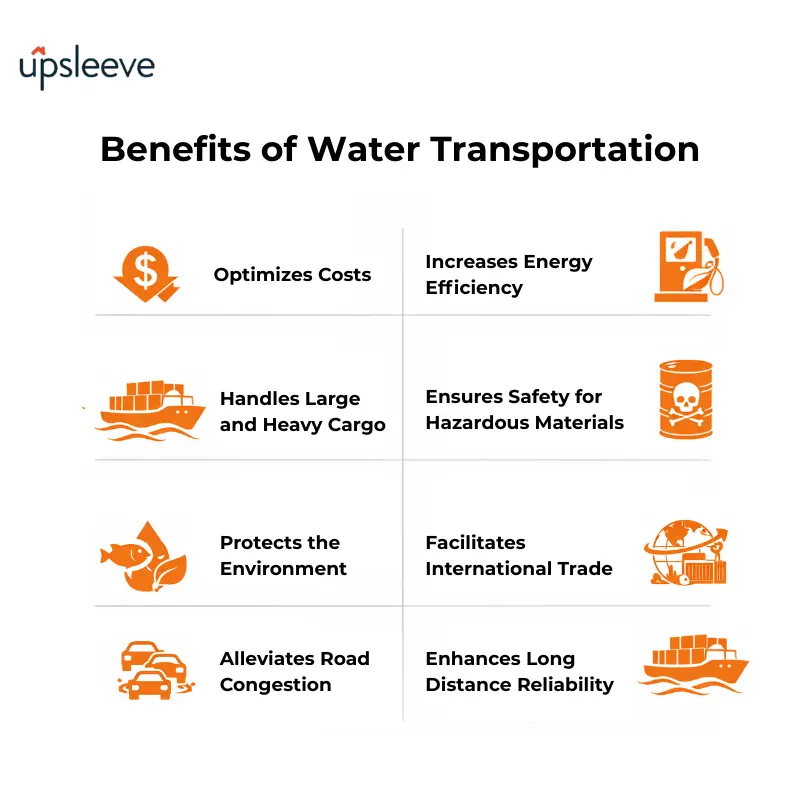
The benefits of water transportation include lower operational costs, higher energy efficiency, environmental protection, safe handling of hazardous materials, facilitation of international trade, reduced road congestion, and reliable long-distance shipping.
Optimizes Costs
Water transport reduces operational and logistical costs by enabling ships to carry large volumes of goods in a single journey, which in turn reduces per-unit shipping expenses. Cost per ton-kilometre (ton-km) for water transport (sea/ inland waterways) is as low as US $0.02 to $0.05 per tonne-km, road transport runs around US $0.15 to $0.30 per tonne-km, and air transport is much higher at US $1.50 to $4.50 per tonne-km. Water transport offers strong economies of scale by allowing bulk shipments of goods to move in a single voyage. Bulk transport capacity allows raw materials, energy resources, and manufactured goods to move efficiently at a fraction of the cost of other transport modes.
Increases Energy Efficiency
Water transportation consumes less fuel per ton of cargo because large vessels distribute energy use across massive load capacities which results in lower fuel consumption per unit moved. Efficient hull designs and slow steaming practices further reduce fuel use and make maritime transport more energy-efficient than road, rail, or air modes. Water transport achieves high fuel efficiency metrics by moving large volumes of cargo with minimal energy per ton-kilometre. Eco-friendly propulsion systems such as cleaner engines and alternative fuels contribute to lower greenhouse gas emissions and makes maritime shipping one of the most environmentally efficient transport modes.
Handles Large and Heavy Cargo
Ships carry oversized and heavy cargo because their decks and holds are designed to support extremely large weights and dimensions that exceed road or air transport limits. Heavy machinery, industrial equipment, and large construction materials are loaded using cranes and specialized handling systems. Unlike roads with weight and size restrictions or airports with cargo hold limits, ships transport multi-ton items safely across long distances.
Ensures Safety for Hazardous Materials
Water transportation provides secure handling of hazardous materials by using specialized tankers designed to safely carry chemicals, petroleum products, and flammable cargo. Specialized vessels feature reinforced hulls, segregated storage compartments, and advanced containment systems to prevent leaks and spills. Strict international and UAE maritime safety regulations govern loading, transport, and emergency procedures for handling hazardous materials. Risk mitigation strategies for safe transport include continuous monitoring, crew training, and emergency response protocols to protect both the cargo and the marine environment.
Protects the Environment
Water transport minimizes environmental impact by producing a lower carbon footprint per ton-kilometre compared to road and air transport. Large water vessels emit fewer pollutants relative to the volume of cargo they carry, which reduces air and noise pollution. Sustainable shipping practices such as slow steaming, cleaner fuels, and energy-efficient hull designs further enhance eco-friendliness. Regulatory compliance and green initiatives also promote responsible maritime operations, which support environmental protection while maintaining efficient cargo movement.
Facilitates International Trade
Water transportation enables global trade by moving massive volumes of goods efficiently across oceans, connecting producers and consumers worldwide. Containerization standardizes cargo handling by allowing quick loading, unloading, and transfer between ships, trucks, and trains. Extensive port networks in major trading nations facilitate seamless international logistics, which reduces delays and costs. The global connectivity due to water transport supports trillions of dollars in annual trade, making maritime transport the backbone of international commerce.
Alleviates Road Congestion
Water transport reduces road traffic by shifting large volumes of cargo from highways to inland waterways and city ports. Inland waterways carry bulk loads in fewer trips, which cuts heavy-truck traffic on major road corridors. City ports support cargo shift from roads by receiving cargo closer to urban markets, that reduce long-distance truck movements inside crowded cities. Intermodal solutions connect ships with rail and short-haul trucks, which lowers pressure on urban transport networks by distributing cargo more efficiently.
Enhances Long-Distance Reliability
Water transport provides reliable long-distance maritime delivery because ships follow fixed schedules and stable shipping lanes that support predictable transit times. These shipping lanes face fewer interruptions than road routes, which slow down due to traffic, accidents or urban congestion. Scheduled vessel movements maintain consistency over long distances by avoiding many weather-related delays that affect land transport. Port handling efficiency further strengthens reliability by ensuring faster cargo processing at departure and arrival points.
What Are the Challenges of Water Transportation?
The challenges of water transportation include slow speed, weather disruptions, limited routes, port congestion, and safety and security issues.
The challenges of water transportation are discussed below.
Slow Speed
Water transport moves much slower than road trucks or air transport, which increases delivery timelines for urgent cargo. Trucks and airplanes reach destinations faster because they travel at higher speeds on shorter routes. The slow movement of water transport over long distances is a key factor in shipping delays. Delays in shipments disrupt supply chains that rely on the timely arrival of time-sensitive goods.
Large vessels travel slowly, which increases the time needed for shipments. Extended route distances also slow down delivery schedules because vessels take many days to travel across long maritime routes before reaching ports that stretch the transit time for time-sensitive shipments. Port handling delays add extra hours to cargo delivery time during loading and unloading. Berth congestion and limited dock space further worsen port handling delays that prolong shipment arrival at the final destination.
Weather Disruptions
Weather disruptions such as storms and high winds increase maritime risks that cause delays in vessel schedules and threaten cargo safety. Rough seas create unstable conditions that damage containers, bulk shipments, and sensitive goods during transit. Shipping companies face higher operational costs when unexpected weather slows transit and causes delivery delays. Cargo insurance claims rise due to damages caused by severe weather events during voyages.
Shipping operators incorporate mitigation strategies such as route planning, weather forecasting, and seasonal navigation adjustments to prevent delays and protect cargo from weather disruptions. Route planning reduces exposure to storm-prone areas and minimizes delays. Weather forecasting allows vessels to adjust sailing times to avoid high-risk periods. Seasonal navigation adjustments help captains select safer routes based on historical storm patterns. Port authorities and shipping operators coordinate schedules to align with predicted weather conditions, which ensures smoother cargo handling.
Limited Routes
Limited routes challenge water transport because vessels can only move along rivers, canals, and coasts that are deep, wide, and equipped for safe navigation which restricts flexibility and routing options. River depth, channel width, and current strength set strict limits on vessel movement along inland waterways. Controlled canal systems provide controlled passages, which also reduce flexibility because ships must follow fixed man-made routes. Port-accessible coasts limit access to areas where docking facilities are available, which prevents vessels from reaching all coastal locations.
Water transport faces additional shipping route limitations due to inland waterways, seasonal closures, and geographic barriers. Inland waterways increase route restrictions when shallow channels and narrow passages limit the movement of vessels. Seasonal closures reduce vessel movement when freezing conditions, low water levels, or monsoon patterns block key river segments. Geographic restrictions limit transport access where mountains, deserts, or remote regions prevent the development of connected waterways. Regional trade flows slow down when these restricted routes disrupt direct or continuous vessel movement.
Port Congestion
Port congestion causes longer loading and unloading times because busy ports face container traffic that exceeds their handling capacity. High container volume fills up terminal space, and filled yards reduce available room for unloading. Limited berth access due to port congestion forces arriving ships to wait for docking positions. Labour shortages at terminals reduce the workforce needed for vessel operation and equipment use, so ships wait at anchorage. Waiting vessels increase sea crowding near the port, which increases overall turnaround time.
Infrastructure constraints at ports limit the number of ships that can be processed simultaneously, which creates further shipping delays because terminals depend on limited cranes, restricted yard layouts, and narrow trucking lanes. Slower equipment performance keeps containers on board for extended periods, so vessels stay idle at ports. Weather checks and safety protocols then add more minutes to the operational window, which pushes the next ship down the queue. Delivery schedules stretch across the supply chain because congested ports delay vessel turnaround beyond planned timelines.
Safety and Security Issues
Safety and security issues threaten cargo protection and crew safety when accidents, collisions, and onboard hazards occur during maritime transport. Accidents damage ship structures, and weaker structures expose cargo to seawater damage and loss. Collisions involve vessel contact with other ships or port infrastructure, and such impact risks crew injury and operational downtime. Onboard hazards include fires from fuel or chemical cargo, and fire outbreaks reduce vessel stability and human safety.
Risk management and preventive measures become essential to maintain vessel readiness for emergency situations. Regular equipment checks confirm that firefighting systems and alarms operate properly, and reliable equipment supports fast incident control. Safety protocols guide crew actions during emergencies, and clear procedures improve response timing. Crew training practices build hazard awareness, and trained personnel manage dangerous tasks with controlled and safe behaviour.
Piracy and theft risks target ships in high-risk zones, and armed groups threaten cargo security and crew welfare. Piracy attacks force ships to slow or divert, and diverted routes increase travel time and insurance costs. Theft attempts occur during slow port operations, and unsecured containers lose high-value goods. Security protocols protect ships in vulnerable waters, and anti-piracy barriers block unauthorized boarding. Crew drills prepare teams for hostile situations, and prepared personnel reduce panic during attacks. Tracking systems support real-time vessel monitoring, and monitored ships receive quick help when threats appear.
Environmental Impact
Environmental impact arises when shipping activities contribute to water pollution, emissions, and marine ecosystem disruption. Ship engines release sulphur oxides and nitrogen oxides, which reduce air quality around coastal regions. Fuel spills contaminate seawater that harms fish, coral and marine plants. Ballast water carries invasive species from one region to another, and foreign species disturb the local marine balance. Underwater noise from vessels affects marine mammals, and disturbed habitats weaken overall ocean biodiversity.
Green shipping practices reduce these environmental threats, and cleaner fuels lower harmful emissions. Emission control systems capture exhaust pollutants, and controlled exhaust protects coastal communities. Ballast water management treats stored water before discharge, which prevents the spread of invasive species. Energy-efficient ship designs reduce fuel consumption that limits both air and water pollution. Regulatory compliance strengthens environmental protection, and strong regulations keep shipping operations safer for oceans and marine life.
Regulatory Compliance
Regulatory compliance creates challenges in water transport because vessels must follow international maritime regulations, local port laws, and safety standards simultaneously. IMO compliance demands strict adherence to navigation, pollution control, and ship construction, and failing to comply increases the risk of fines or detention. Documentation requirements for cargo, crew, and inspections add operational complexity, and incomplete records delay port clearance. Penalties for non-compliance, including license suspension or heavy fines, force shipping companies to constantly monitor evolving regulations, which strains management and resources.
Local port laws intensify challenges as docking procedures, cargo handling, and harbour safety vary across regions, and inconsistent rules slow operations. Safety standards demand functional lifesaving equipment and trained crews. IMO audits and inspections highlight discrepancies, and audit failures can block port access or affect insurance approvals. Regulatory compliance thus becomes a persistent operational and financial challenge that influences shipping efficiency, legal safety, and overall marine risk management.
Multimodal Transfer Coordination
Multimodal transfer coordination is a key challenge in water transport because moving containers between ships, trucks, and trains requires seamless timing and precise handling. Container handling slows when cranes, forklifts, or trucks cannot match vessel operations, and misaligned processes delay cargo movement. Infrastructure compatibility adds more pressure and hurdles when ports and terminals lack the equipment or layout to support efficient transfers, and limited space forces ships and land vehicles to wait.
Scheduling conflicts extend delays as late vessel arrivals affect planned truck or train departures, and idle containers occupy valuable terminal areas. Regulatory differences between transport modes complicate operations, and incomplete documentation further slows transfers. Crew and logistics teams must coordinate equipment use and handling practices effectively, and smooth coordination ensures cargo integrity, reduces delays, and maintains overall intermodal reliability.
How Does Water Transportation Compare to Road, Rail, and Air?
The comparison of Water, Road, Rail, and Air Transportation is given in the table below.
| Factor | Water Transport | Road Transport | Rail Transport | Air Transport |
|---|---|---|---|---|
| Speed | Slowest; long transit time | Medium; flexible routes | Fast on fixed routes | Fastest; shortest delivery time |
| Cost | Lowest cost per ton-km | Higher due to fuel & tolls | Moderate | Highest due to fuel & handling |
| Cargo Capacity | Largest capacity (ships carry bulk, containers, vehicles) | Limited capacity (trucks) | High capacity for bulk & containers | Very limited cargo space |
| Environmental Impact | Lower emissions per ton-km | Moderate emissions | Low to moderate | Highest emissions |
| Accessibility | Limited to ports | Door-to-door access | Limited to rail stations | Limited to airports |
| Best Use-Case | Heavy cargo, bulk goods, long distances | Local deliveries & flexible routes | Large loads on land corridors | High-value or urgent cargo |
Which Is the Best Mode of Transportation on Water?
The best mode of transportation on water depends on the vessel type and the nature of the cargo being moved. Container ships handle electronics, clothing, machinery, and packaged items because their standardized containers allow secure stacking, fast loading, and easy intermodal transfer. Bulk carriers transport unpackaged materials like coal, grain, and ores as their wide cargo holds support high-volume, low-cost movement of raw commodities. Tankers move liquid products such as crude oil, LNG, and chemicals because their insulated and pressure-controlled tanks preserve cargo quality over long hauls. RO-RO vessels carry cars, trucks, and heavy machinery since wheeled cargo can be driven on and off, reducing port time and operational handling.
Economic factors influence vessel choice because fuel cost, port fees, and cargo value shape the overall freight decision. Environmental factors matter because LNG-powered engines, slow-steaming practices, and optimized hull designs reduce emissions on major ocean routes. Operational factors guide vessel selection because draft limits, port equipment, and cargo-handling time determine which vessel delivers the safest and most efficient transport.
How to Choose the Best Water Transportation Mode or Service?
To choose the best water transportation mode or service, follow the steps given below.
- Assess Cargo Type: Identify whether the shipment is liquid, bulk, vehicles, or general goods to determine which vessel types are suitable.
- Check Cargo Volume and Weight: Heavy or large cargo fits bulk carriers, while smaller loads suit container ships or RO-RO vessels.
- Examine Shipping Routes: Distance, port depth, and navigational restrictions affect vessel compatibility and transit time.
- Review Loading and Unloading Needs: Quick transfer or multiple stops favour RO-RO vessels or container ships with cranes.
- Consider Costs: Fuel, port fees, and freight rates determine the most economical option.
- Evaluate Environmental Impact: Fuel type, emission standards, and hull design affect the ecological footprint.
- Assess Operational Constraints: Port equipment, draft limits, and turnaround time guide safe and efficient transportation mode or service.
- Select the Water Transport Service: Compare available carriers, check their schedules, reliability and safety records, then choose the best option of transportation mode or service for safe and efficient shipping.
Is Water Transport the Cheapest Mode of Transportation?
Yes, water transport is the cheapest mode of transportation for moving goods over long distances. Shipping cost depends on distance, cargo type, vessel size, and port fees, as larger vessels lower per-unit costs while specialized cargo increases transport expense. Per ton-kilometer costs for container ships, bulk carriers, and tankers are lower than road and rail transport, and significantly cheaper than air freight for heavy or bulky shipments. Companies like Upsleeve provide cost-effective shipping across the UAE, combining vessel selection, route planning, and port handling.
What Goods Are Best Transported by Water?
The goods best transported by water include bulk commodities like coal, iron ore, grains and cement, liquid bulk such as crude oil, petroleum products and LNG, containerized cargo including electronics, machinery and apparel, and oversized/heavy cargo like large industrial equipment, steel and vehicles. Bulk commodities are transported on large and high-capacity ships designed to carry heavy loads efficiently over maritime routes. Liquid cargo like crude oil and LNG moves on specialized tanker ships built for safe handling of liquids. Oversized cargo is carried on roll-on/roll-off or project cargo vessels that can handle heavy or unusually sized items. Containerized goods are shipped in containers that protect them during long voyages without rapid deterioration.
How Safe Is Water Transportation in the UAE?
Water transportation in the UAE is considered highly safe because UAE maritime authorities apply strict safety protocols, advanced navigational systems, certified crew training, and mandatory vessel insurance to maintain maritime safety. UAE ports use AIS tracking, radar systems, and coastal monitoring units to support vessel routing which strengthens the crew training programs that cover emergency drills, equipment handling, and collision-avoidance procedures.
Crew training supports vessel insurance requirements as insurance companies rely on certified safety compliance before approving coverage linked to vessel security and cargo protection. UAE maritime records show a steady decline in major marine accidents, including a reduction of more than 40% in collision incidents reported by the Federal Transport Authority over the past decade. Insurance-backed safety programs keep water transportation stable across coastal shipping routes and passenger ferries.
What Is the Role of Ports in Water Transport?
Ports play a central role as operational hubs in water transport by managing cargo handling, storage operations, customs clearance, and passenger services as primary functions. Port moves containers, bulk cargo, and roll-on/roll-off units (RORO units) through organized loading and unloading processes controlled by port terminals and crane systems. Port authorities regulate vessel berthing and oversee customs inspections to keep trade channels open for domestic and international shipments. Maritime gateways support national economies by keeping import and export flows active through major shipping lines, freight forwarders, and bonded warehouses built on strong port infrastructure.
Intermodal connections link ports with trucks, rail lines, logistics parks, and distribution warehouses to keep cargo movement continuous across supply chains. Port logistics teams supervise yard operations, container stacking, equipment deployment, and routing schedules for better operational order. Crane systems, conveyor units, and automated yard vehicles control vessel turnaround time through coordinated movement. Efficiency programs in ports use digital tracking, berth allocation systems, and cargo flow monitoring to support smoother maritime transport.
Related Articles
Use a complete moving out checklist to plan, pack, notify utilities, clean, inspect your property, avoid delays, and ensure a smooth, stress-free move.
Learn what relocation means in the UAE, its main types, costs, and a clear step-by-step guide to relocate smoothly with legal, housing, and moving tips.

Discover 12 benefits of hiring professional movers and packers in the UAE, including safe packing, faster moves, cost savings, insurance, and stress-free relocation.
Ready to Move?
Get Your Free Quote
Today
We make moving simple, safe, and stress-free. Our professional team handles everything from packing to delivery with care and precision.
- Professional packing & unpacking services
- Fully insured and licensed movers
- Same-day & next-day availability
- Free, no-obligation estimates
Request a Quote
Fill out the form below and we’ll get back to you as early as possible.